Best Greyhound Betting Sites – Bet on Greyhounds in 2026
Loading...
Before a greyhound reaches the starting boxes, decisions have already been made about where it will run. The seeding system—GBGB’s method of allocating dogs to traps based on their running style—shapes every race before the lids lift. Understanding how R, M, and W classifications work transforms the race card from a list of names into a map of probable racing lines.
Seeding is where preparation meets position. A dog classified as a railer belongs on the inside; a wide runner needs the outside. Middle runners offer flexibility that racing offices exploit to fill gaps in the draw. These aren’t arbitrary labels. They reflect observed behaviour across multiple races, codified into a system that aims to produce fair, competitive contests while minimising interference at the first bend.
The system operates under GBGB Rules 76 and 80, which govern trap allocation and grading. Racing offices at each track apply these rules to construct cards that match dogs to appropriate positions. The process is now largely automated through a cryptographic random number generator, removing the human discretion that historically created controversy over draw manipulation. What remains is a technical framework that punters must understand to read form accurately.
This explanation covers each seeding classification, the regulatory framework that governs allocation, and the practical implications for betting. Whether you’re interpreting race cards for the first time or refining an existing approach, knowing how dogs end up in their traps reveals information that the form figures alone don’t provide.
What Is Seeding?
Seeding is the process of assigning greyhounds to traps based on their demonstrated running style. Every licensed greyhound carries a seeding classification—R for railer, M for middle runner, or W for wide runner—that determines which traps they can be drawn into. The classification appears on race cards alongside the dog’s form, enabling punters to assess whether a draw suits the runner’s natural tendencies.
The underlying logic is straightforward: dogs have preferences. Some greyhounds instinctively break for the rail and stick to it through the bends. Others show no such inclination, preferring to run wider where they have more room. Still others adapt to circumstances, railing when the opportunity presents and running wide when it doesn’t. These behavioural tendencies, observed across trials and races, determine the classification.
In theory, every trap should win approximately 16.67% of races—the mathematical result of six dogs competing with equal chances. Reality differs because dogs are not interchangeable. Seeding acknowledges this by placing rail-preferring dogs where they can access the rail, wide-preferring dogs where they can run outside, and flexible dogs in positions where adaptability matters. The result is racing that reflects genuine competition rather than chaos.
Racing offices assign seeding classifications after reviewing a dog’s trial performances and early races. First-time runners typically carry middle seeding (M) until they establish a pattern. Experienced dogs may have their classification revised if their running style changes—injury recovery, age, or training adjustments can all shift preferences. The classification is a snapshot, not a permanent fixture.
Seeding also serves a safety function. Dogs that crowd the rail when drawn wide create interference risks; wide runners forced inside may cause trouble at the first bend. Matching running style to trap position reduces these hazards. The GBGB’s welfare strategy explicitly links proper seeding to injury prevention, recognising that appropriate trap allocation contributes to safer racing.
For punters, seeding provides context that raw form figures miss. A dog with strong recent results but unsuitable seeding for today’s draw faces obstacles that don’t appear in the win-loss record. Conversely, a moderate performer drawn in their preferred position might outrun their odds. Reading seeding alongside form separates informed punters from those betting blind.
Railer (R) — Inside Runners
Railers are greyhounds that naturally seek the inside running line. From the break, they angle towards the rail and maintain that position through the bends. This running style minimises distance travelled—the rail represents the shortest path around the track—and provides a reference point that some dogs find reassuring. Railers drawn to inside traps (typically 1 and 2) have immediate access to their preferred line.
The rail advantage varies by track. At venues like Towcester, where trap 1 wins at approximately 20%, railers benefit from geometry that rewards early rail possession. The run to the first bend is configured so that a clean-breaking railer can establish position before interference develops. Once on the rail, the dog covers less ground than rivals who must navigate wider paths. According to analysis from Towcester Racecourse, trap 1 at certain venues has recorded win rates as high as 58% on individual cards—an extreme example of how track configuration and seeding alignment can amplify inside advantage.
Railers drawn to middle or outside traps face challenges. A dog classified R but allocated trap 4 must cross runners to reach the rail, creating interference risk and covering extra ground in the process. Whether the railer can negotiate this traffic depends on early pace: fast-breaking railers can cut across before rivals establish position; slower breakers may find the rail already occupied. The drawn position shapes the race before the lids open.
Identifying railers on the race card requires attention to the seeding letter and recent form. Strong railers show consistent rail running in their comment lines—phrases like “railed throughout” or “led at first bend” indicate a dog executing its natural style. Railers that show “checked first bend” or “crowded rails” may be suffering from unfavourable draws or competitive inside fields where multiple dogs target the same line.
Betting on railers means betting on their access to the rail. A top-rated railer drawn trap 1 in a field with few other railers faces an easy path to its preferred position. The same dog drawn trap 3 behind two other railers faces traffic. The seeding distribution of the entire field matters, not just the individual dog’s classification. Reading the full draw reveals whether today’s race suits the railer or works against it.
Track conditions affect railers disproportionately. Wet surfaces make the inside running line slower as water accumulates near the rail. Railers committed to the rail may lose ground they’d gain on dry surfaces. Seasonal punters adjust their view of railers based on recent weather and track reports, downgrading inside positions when conditions favour wider running.
Middle Runner (M) — The Flexible Option
Middle runners adapt. Classified M, these greyhounds show no strong preference for inside or outside lines, instead responding to how races develop. They can rail when the opportunity presents, run wide when traffic blocks the inside, or hold their position through the field. This flexibility makes them the most common classification and the most difficult to assess from the draw alone.
Racing offices assign middle seeding to dogs that show variable running patterns. A greyhound that rails in some races but runs wide in others accumulates a mixed profile that defies easy categorisation. First-time runners typically receive M classification by default until their running style clarifies. The middle designation thus covers both genuinely flexible dogs and those whose preferences haven’t yet been established.
Middle runners drawn to traps 3 and 4 occupy the positions that statistically produce the highest win rates nationally. Trap 3 averages above 18% across UK tracks, and middle seeding contributes to this pattern. Dogs in central positions can adjust their racing line based on the break—cutting inside if the rail opens, swinging wide if the middle crowds. The positional versatility that defines M classification aligns with the tactical advantages of central traps.
Assessing middle runners requires deeper form reading than railers or wide runners. The seeding letter tells you the dog can adapt; the form reveals how effectively it uses that adaptability. Middle runners with comments like “found room on inside” or “switched wide” demonstrate active race management. Those showing “bumped” or “nowhere to go” may lack the pace or awareness to exploit their flexibility.
In competitive fields, middle runners face the most variable outcomes. Their lack of commitment to a specific line means their paths depend heavily on what other dogs do. A middle runner between two fast-breaking railers may find itself squeezed; the same dog between slower breakers might cruise through unmolested. The quality and seeding of rivals matters more for M dogs than for specialists who commit to their preferred line regardless of traffic.
Some trainers actively develop middle-running tendencies to give their dogs more draw options. A dog that can perform from traps 2-5 has more racing opportunities than one limited to traps 1-2 or 5-6. The commercial logic of maximising runs drives some seeding flexibility, which punters should consider when evaluating whether a dog’s M classification reflects genuine adaptability or trained tolerance.
Wide Runner (W) — Outside Specialists
Wide runners prefer racing room over the shortest line. Classified W, these greyhounds break from outside traps and maintain wider racing paths through the bends. They sacrifice distance economy for cleaner running, avoiding the interference that clusters near the rail. At tracks configured to suit wide running, this trade-off pays off; elsewhere, the extra ground proves costly.
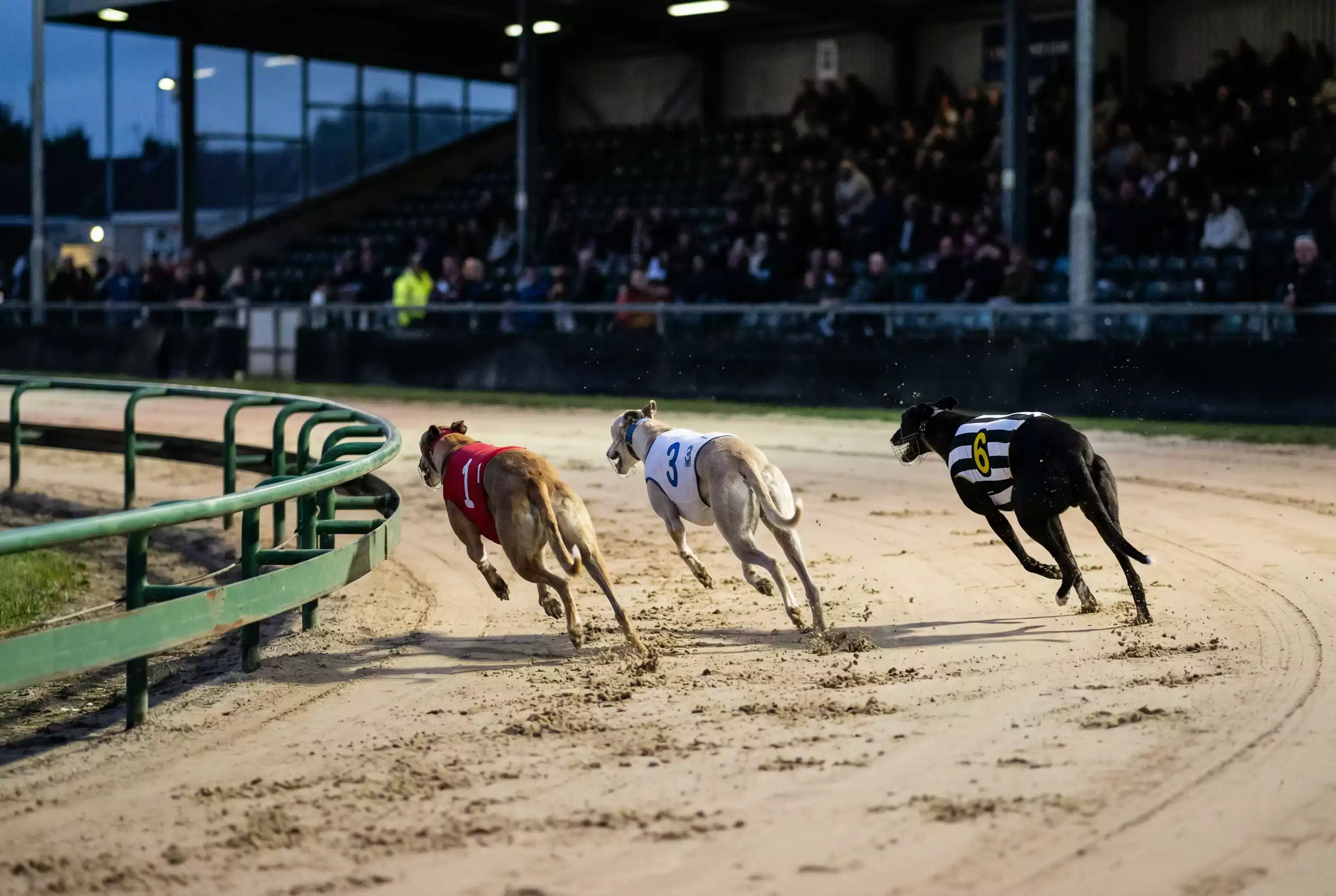
Wide seeding typically assigns dogs to traps 5 and 6, where they have immediate access to outside running lines. From trap 6—the striped jacket—a wide runner can break outward, clear the traffic at the first bend, and establish position without confronting the pack fighting for inside spots. The path is longer, but if the dog carries sufficient early pace, the unimpeded run compensates for additional distance.
Harlow illustrates the wide-runner advantage. Trap 6 at Harlow wins at 21%, approximately five percentage points above the national average for that position. The track’s geometry—particularly the approach to the first bend—allows wide runners to hold their line without losing prohibitive ground. Dogs seeded W and drawn into trap 6 at Harlow benefit from a structural advantage that persists across seasons and different dog populations.
Wide runners drawn to inside traps face the inverse problem of railers drawn outside. A W-classified dog in trap 2 must either compromise its natural tendency or cross traffic to reach a wider line. Neither option is ideal. Some wide runners have enough early pace to clear the field and swing outside regardless of draw; others find themselves trapped behind slower dogs with no path to their preferred racing room.
Form comments reveal how wide runners execute their style. Phrases like “always wide” or “made ground outside” indicate a dog running as seeded. “Crowded” or “no room” suggest a wide runner that couldn’t access its line. The seeding classification tells you intent; the form tells you execution. Successful wide runners combine the two—W seeding plus consistent demonstration of effective wide running.
Weather affects wide runners differently than inside specialists. Heavy, wet conditions deteriorate the outside running line first, creating uneven going that slows wide runners while inside dogs find better footing near the rail. Summer conditions typically favour wide running, with drier, firmer surfaces maintaining quality across the full track width. Seasonal punters adjust their view of W dogs based on surface conditions.
GBGB Rules 76 and 80
The seeding system operates under GBGB Rules 76 and 80, which establish the regulatory framework for trap allocation and grading. Rule 76 governs how dogs are classified by running style; Rule 80 addresses how those classifications translate into trap assignments. Together, they create a structured process that aims to produce fair racing while maintaining welfare standards.
Rule 76 requires racing managers to assess each greyhound’s running style based on observed performance. The assessment considers multiple factors: how the dog breaks from the boxes, which line it takes to the first bend, how it navigates bends throughout the race, and whether it maintains consistent patterns across different draws. Dogs showing clear rail preference receive R classification; those demonstrating wide running get W; and those exhibiting flexibility are assigned M.
These classifications are not permanent. Rule 76 permits reclassification when a dog’s running style changes. Injury recovery, ageing, training adjustments, or simply accumulated racing experience can shift preferences. Racing managers monitor performances and adjust classifications to reflect current behaviour rather than historical patterns. A railer that begins running wide may be reclassified; a middle runner showing increasing rail preference may become an R.
Rule 80 governs how seeding translates into draw allocation. The rule mandates that dogs be drawn into trap ranges appropriate to their classification: railers to inside positions, wide runners to outside positions, middle runners to any trap. Racing offices construct cards that respect these constraints while balancing competitive fields and managing trainer requests.
The GBGB enforces these rules through oversight of racing operations. Stewards review race cards to ensure compliance with seeding requirements. Non-compliance—such as systematically drawing railers to outside traps—can result in sanctions against racing officials. This enforcement mechanism ensures that seeding operates as intended rather than being circumvented for convenience.
Stakeholder education supports the regulatory framework. The GBGB reported that stakeholders received 582 hours of free continuing professional development in 2024, including training on seeding procedures and welfare implications. “We are realists within this sport and we are actively involved in the welfare of greyhounds on a daily basis. We are not a sport that pontificates or plays to the crowd. We get on with doing the right thing,” observed Jeremy Cooper, former Chair of the GBGB. This training ensures that racing office staff understand their obligations under Rules 76 and 80.
For punters, understanding the regulatory framework provides confidence that seeding classifications mean what they claim. The system isn’t arbitrary; it reflects structured observation and ongoing monitoring. When a race card shows a dog seeded R in trap 1, that classification represents a formal assessment under Rule 76, assigned to an appropriate trap under Rule 80, and subject to stewardship oversight.
The Automated Draw System
Trap allocation in UK greyhound racing now runs through an automated system using cryptographic random number generation. This technological infrastructure, introduced in 2025, removes human discretion from the draw process. Dogs meeting seeding and grading criteria for a race are entered into the system, which assigns traps according to Rule 80 constraints without manual intervention.
The shift to automation addresses historical concerns about draw manipulation. When racing officials manually assigned traps, questions arose about favouritism—whether certain trainers received better draws, or whether specific dogs were systematically helped or hindered. The automated system eliminates this vector for unfairness. Within the constraints of seeding requirements, trap assignment is genuinely random.
Cryptographic RNG provides a higher standard of randomness than simpler methods. The system uses cryptographic algorithms that produce numbers resistant to prediction or manipulation. Even with complete knowledge of the algorithm, predicting the next output is computationally infeasible. This technical standard ensures that draw outcomes cannot be gamed by anyone with inside access.
The automation integrates with the broader racing management infrastructure. When a racing office constructs a card, the system identifies eligible dogs based on grading, seeding, and availability. It then assigns traps within seeding constraints, producing a complete race card without requiring manual trap selection. Racing managers retain oversight—they can review and confirm assignments—but the generation itself is hands-off.
Transparency accompanies automation. The GBGB’s welfare strategy documentation references the automated draw as part of broader modernisation efforts. The system produces auditable records of how traps were assigned, providing evidence for any subsequent inquiries. Stewards reviewing races can verify that draws complied with rules by examining system logs.
For punters, automation means that draw outcomes can be treated as genuinely random within seeding constraints. Historical concerns about “dodgy draws” become less relevant. What remains are the structural factors—track geometry, seeding accuracy, and competitive dynamics—that determine whether a particular draw suits a particular dog. The randomisation is fair; the interpretation is up to you.
Some traditional punters miss the days when draw analysis could identify systematic patterns—racing offices that favoured certain trainers, or tracks where inside draws were disproportionately assigned to lower-quality dogs. The automated system closes those angles. What it opens is a cleaner analytical environment where trap statistics reflect genuine track characteristics rather than administrative quirks.
How Seeding Affects Betting
Seeding information appears on every race card, but not every punter uses it. Those who incorporate seeding into their analysis gain an edge over those who ignore it. The classification letters—R, M, W—provide insight into how each dog will likely approach the race, which in turn affects how traps translate into racing lines and potential interference.
The simplest application is draw suitability. A railer in trap 1 is well drawn; the same dog in trap 5 faces obstacles. When assessing a race, scan the seeding column and note whether dogs are positioned to execute their natural running styles. Favourable draws support form expectations; unfavourable draws create risks that form figures don’t capture.
Field composition matters as much as individual draws. A railer in trap 2 behind another railer faces a different race than the same dog in trap 2 with no other railers in the field. The seeding distribution of the entire field determines how crowded different racing lines will be. Fields loaded with railers create congestion on the inside; fields heavy with wide runners open up the rail.
Odds often fail to account properly for seeding mismatches. When a dog’s recent form comes from favourable draws, market prices may overestimate its chances from a less suitable position. Conversely, a dog with moderate form from poor draws might offer value when finally drawn to suit. The market prices form; you can price the draw.
Forecast and tricast betting rewards seeding awareness. Constructing finishing orders requires anticipating how the race will unfold—who leads, who gets crowded, who finds room. Seeding tells you which dogs are likely to target which lines, enabling informed speculation about where trouble will develop and who will avoid it. Middle runners drawn centrally often provide place value because they can navigate whatever chaos develops.
Long-term profitability from seeding requires consistent application. One race’s outcome reflects chance as much as seeding effects. Hundreds of races, analysed and bet with seeding awareness, reveal the patterns that translate into returns. The information is public, available on every race card; the edge comes from using it systematically when others don’t.
Key Takeaway
The seeding system classifies greyhounds by running style—railers (R) seek the inside, wide runners (W) prefer the outside, and middle runners (M) adapt to circumstances. GBGB Rules 76 and 80 govern how these classifications are assigned and how they translate into trap positions. The automated draw system, using cryptographic random number generation, now assigns traps within seeding constraints without human intervention.
Understanding seeding transforms race card reading. The classification letters reveal likely racing lines, potential interference points, and draw suitability for each runner. Dogs drawn to execute their natural styles face easier races than those fighting their seeding. Field composition—the seeding distribution of all runners—determines how crowded each line will be.
Seeding is where preparation meets position. The classifications exist because dogs have preferences, and matching those preferences to traps produces fairer, safer racing. Punters who read seeding alongside form identify opportunities that the market’s casual participants miss. The information is public; the advantage comes from using it.