
Introduction
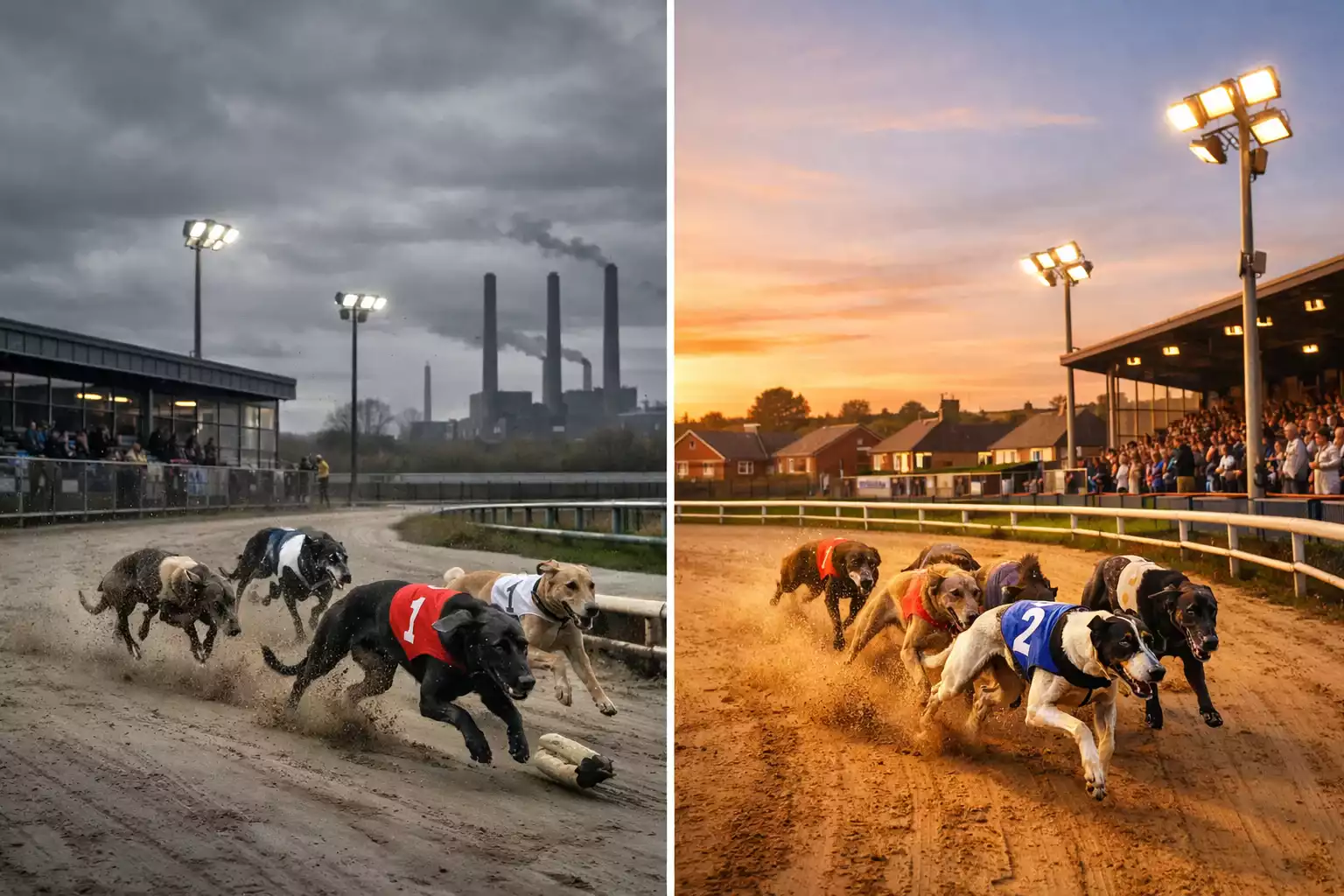
The 19 GBGB-licensed stadiums scatter across England from Essex to South Yorkshire. Each region carries its own racing culture, its own core tracks, and its own patterns that bettors can exploit. London dominates the southern circuit; the Midlands and North offer a different character entirely. Understanding regional differences is part of understanding greyhound racing itself, and neglecting them means missing half the picture.
Every region has its racing character. That phrase applies to more than atmosphere. Tracks in different parts of the country attract different pools of dogs, run on different surfaces, and produce different statistical outcomes. A punter who specialises in London racing may find the northern tracks unfamiliar in ways that go beyond geography. Regional knowledge is local knowledge, and local knowledge is edge. The punter who masters one region gains an advantage over those who spread their attention too thin.
Each venue is profiled in the track directory.
London and South East
London has been the heart of British greyhound racing since the sport arrived in 1926. The capital and its surroundings host several major tracks, each with distinct characteristics. Romford, in Essex, is the flagship venue for evening racing and the best-known track in the country. Its tight turns and fast sand surface produce dramatic races and a pronounced Trap 3 advantage.
Crayford, which closed in January 2025, was the last track in the UK to offer hurdle racing. Its departure marked the end of an era and reduced the southeastern circuit. The closure reflected broader economic pressures facing the sport, though Crayford’s unique hurdle format had long made it a niche interest rather than a mainstream fixture.
Central Park in Kent operates a smaller circuit with its own following. Wimbledon, historically one of the premier tracks in the world, closed in 2017, leaving Romford as the unchallenged leader of the London scene. The capital’s tracks tend to attract larger fields, more media coverage, and stronger betting markets than provincial venues.
The southeastern region produces a particular type of racing. Proximity to breeders in Ireland and East Anglia means tracks here see a steady supply of quality dogs. The competitive depth is higher than at some northern venues, which can affect favourite win rates and create tighter betting markets. Punters who focus on Romford benefit from extensive data, published statistics, and active online discussion—resources that thin out as you move away from London.
Weather in the southeast is relatively mild, and tracks rarely face the extreme conditions that affect northern venues in winter. That consistency makes form study more reliable: a dog’s performance in October is more likely to translate to March performance at Romford than at a track subject to harsher seasonal variation.
Midlands and North
The Midlands forms the second cluster of UK greyhound racing. Monmore Green in Wolverhampton is the standout venue, hosting regular televised meetings and maintaining a strong racing population. The track’s sweeping bends and longer run to the first turn produce different trap dynamics than the tight London circuits. Inside bias exists but is less pronounced than at some southeastern tracks.
Perry Barr in Birmingham, Nottingham, and Newcastle round out the northern circuit. Each track has its own character. Perry Barr sits in a densely populated area and draws strong local crowds. Newcastle, at the far end of the licensed circuit, serves the northeast and produces quality racing despite geographical isolation from the sport’s southern heartland.
Sheffield’s Owlerton Stadium combines greyhound racing with speedway, sharing facilities in a way that creates a distinct local culture. The track is tighter than Monmore but larger than Romford, landing somewhere in between for trap bias calculations. Yorkshire punters have supported Owlerton for generations, creating a loyal following that sustains racing even as national attendance figures decline.
The northern region faces different challenges from the south. Distances between tracks are greater, making it harder for trainers to run dogs at multiple venues in a single week. The breeding and supply chain is less concentrated, and some tracks struggle to fill competitive fields consistently. These factors can inflate favourite win rates at weaker venues, where a single standout dog may face inferior competition.
Weather plays a larger role in the north. Winter meetings at Sheffield or Newcastle can face postponement due to frost or heavy rain. Track surfaces deteriorate more quickly under harsh conditions, and going can change dramatically within a meeting. Punters betting on northern racing need to factor in conditions more heavily than those focused on the milder southeast.
The wider context is set out in our guide to UK greyhound traps.
Regional Betting Patterns
Regional differences extend to how races are bet. London tracks attract national media coverage and sharp betting markets. Romford’s evening cards are broadcast widely, and prices are set by experienced bookmakers who know the track intimately. Finding value is harder because the market is efficient, and every statistical tendency is already priced in.
Provincial tracks receive less attention. Monmore and Sheffield appear on television, but other venues operate largely off the mainstream radar. Betting markets at smaller tracks can be thinner and less well-formed. Local knowledge becomes more valuable where national expertise is scarce. A punter who studies Nottingham’s quirks may find edges that simply do not exist at Romford.
Trap statistics vary regionally. Inside bias is common across the country, but the degree varies. Southern tracks with tighter turns tend to amplify inside advantage. Northern tracks with longer straights and gentler bends produce flatter trap distributions. Understanding these patterns requires venue-specific study rather than national generalisations. What works at Romford may fail at Newcastle, and what succeeds in Sheffield may not translate to Central Park.
Travelling dogs add another layer of complexity. A dog trained in the southeast may race at Monmore occasionally, bringing form that is hard to compare directly. Trainers sometimes exploit regional differences by targeting tracks where their dog’s running style fits the configuration. A wide runner that struggles at Romford might thrive at a northern venue with more room to manoeuvre. Spotting these patterns before the market does is one way to find value.
Betting volume also differs by region. London tracks handle larger pools, which means better liquidity and smaller price movements. Provincial tracks see smaller pools, which can lead to sharper swings and less predictable prices. For pool bettors using the Tote, regional volume differences can affect returns significantly.
Key Takeaway
UK greyhound racing divides into regional clusters, each with distinct character. London and the southeast offer sharp markets, strong fields, and consistent conditions. The Midlands and North provide different track geometries, smaller racing populations, and more variable weather. While welfare organisations like Dogs Trust have called for an end to racing, stating: “We worked closely with the greyhound industry for many years to try to improve welfare conditions for the dogs… progress has not been made quickly enough”—the sport continues at licensed venues across England. Every region has its racing character—learn the local nuances, and you will find angles that punters relying on national averages will miss. Regional specialisation is a viable strategy for serious bettors willing to invest time in knowing one part of the circuit deeply.
