Best Greyhound Betting Sites – Bet on Greyhounds in 2026
Loading...
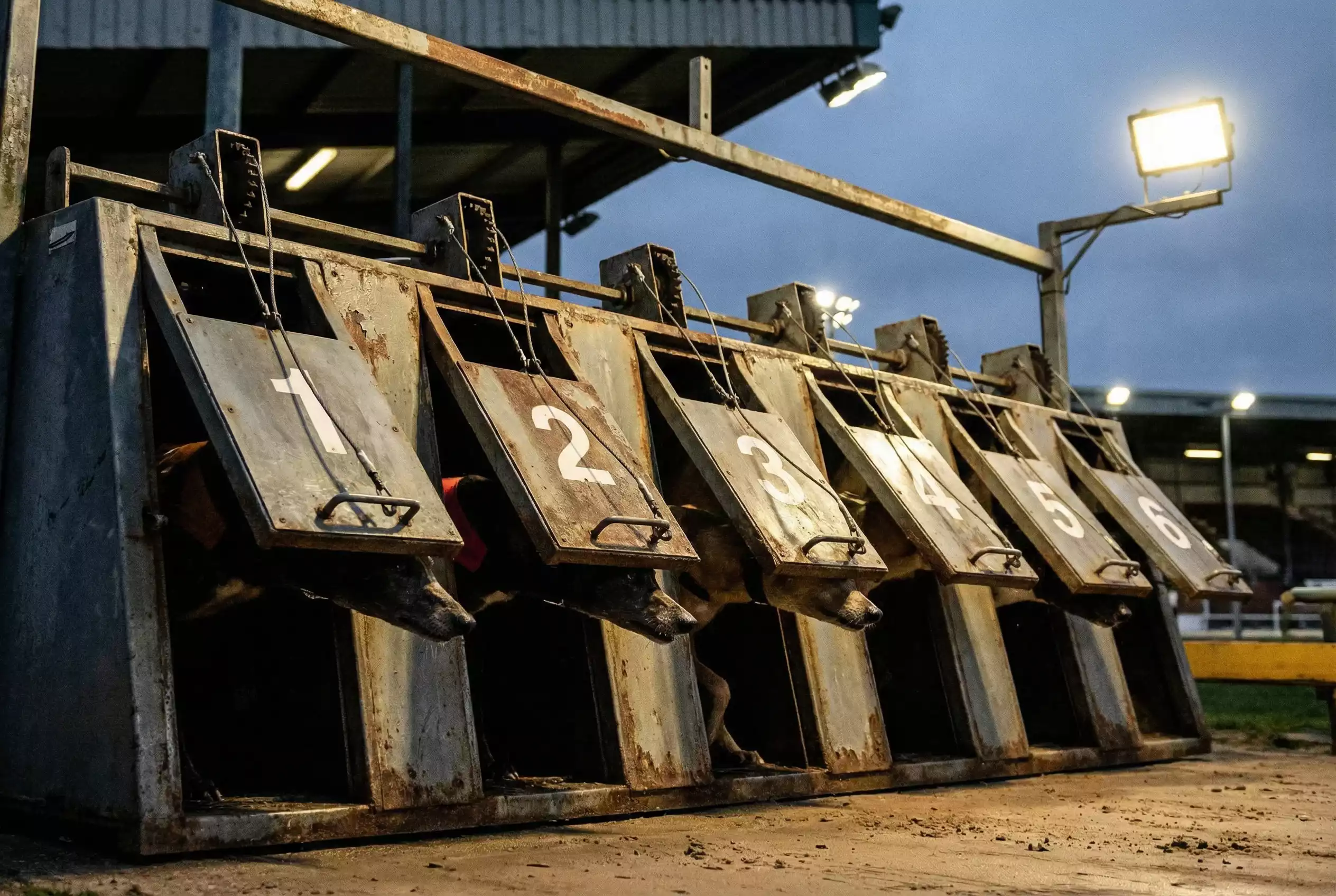
Six doors, one moment, milliseconds to spare. That is the starting trap in a sentence. But beneath that simplicity lies precision engineering designed to ensure that every greyhound race begins fairly. The trap must hold excited dogs securely, release all six simultaneously, and do so race after race without failure.
For punters analysing trap draws, understanding how the box works adds depth to form study. A dog that behaves nervously in the trap or breaks slowly when doors open may show patterns traceable to mechanics as much as temperament. This guide examines what happens inside and around the starting box, from the structure itself to the release system that sets the race in motion.
The Anatomy of a Starting Trap
A standard greyhound starting assembly contains six individual traps arranged in a line perpendicular to the track’s inside rail. Each trap is a metal enclosure just large enough to hold one greyhound comfortably—typically around 75 centimetres long, 50 centimetres wide, and 90 centimetres high. The dimensions allow the dog to stand, shift weight, and focus on the lure without being cramped.
The front of each trap features a hinged door that swings upward when released. This upward motion is deliberate: a door swinging outward could strike or startle adjacent dogs, while a door retracting inward would block the exit. The upward swing clears the path instantly, letting the dog burst forward without obstruction.
The rear of the trap is typically open or fitted with a gate that remains secured during loading. Handlers back dogs into the trap, positioning them facing forward. Once the dog is in place, the rear gate closes or a handler confirms readiness. This loading process occurs for all six traps in sequence, with experienced handlers working quickly to minimise the time dogs spend confined before the race.
Ventilation matters. Greyhounds in the moments before a race are in a heightened state—alert, excited, sometimes anxious. Adequate airflow through the trap prevents overheating and reduces stress. Modern traps use mesh panels or perforated metal rather than solid walls, allowing dogs to sense the track environment while remaining contained.
The floor of each trap is usually textured to give dogs grip when they launch forward. A slippery surface would cause hesitation or stumbles at the break, negating any trap-position advantage. Tracks maintain these surfaces regularly, replacing worn or damaged flooring to ensure consistent conditions across all six boxes.
Colour coding matches the jacket system. Trap 1 may be marked with red trim, trap 2 with blue, and so on, helping handlers, stewards, and camera operators identify positions instantly. This redundancy—jacket colour plus trap marking—prevents loading errors that could derail an entire race card.
Simultaneous Release System
The defining feature of greyhound traps is simultaneous release. All six doors must open at the same instant, giving no dog an advantage from timing alone. Achieving this requires either mechanical linkage or electrical synchronisation.
Mechanical systems use a single actuator—typically a cable or rod—connected to all six door latches. When the starter triggers the release, the actuator moves and all latches disengage together. The simplicity of this approach made it standard in early racing. However, cable stretch, friction, and wear could introduce small delays between traps, creating inconsistencies invisible to the eye but meaningful in race outcomes.
Electrical systems, now universal at GBGB-licensed tracks, replaced mechanical linkages with solenoid-operated latches. Each door has its own electromagnet holding the latch closed. When the starter activates the circuit, all solenoids release simultaneously. Because electrical signals travel at effectively instantaneous speeds, the timing variance between traps shrinks to negligible levels—hundredths or even thousandths of a second.
The switch from mechanical to electrical systems was gradual, driven by evidence that even small inconsistencies affected race outcomes and betting markets. A trap opening five-hundredths of a second late might cost a dog a length at the first bend—a disadvantage that no amount of speed could always overcome. Punters and trainers noticed patterns: certain traps at certain tracks seemed to produce worse breaks. Electrical synchronisation eliminated this variable.
The starter controls the release from a position with clear sight of both the traps and the approaching hare. Timing is critical: the doors must open when the hare passes the boxes at a speed that encourages chasing without dangerous close quarters at the break. Opening too early leaves dogs waiting; opening too late means the hare pulls away before they can lock onto it. Experienced starters develop an intuitive sense for this timing, coordinating with the hare driver to ensure smooth starts.
Sensors confirm that each door has opened. If a door sticks or fails to release, the system can flag the issue before official race timing begins. In extreme cases, a mis-start may be declared and the race rerun—though such incidents are rare at well-maintained tracks.
Safety Features
Traps are designed to minimise injury risk at the most chaotic moment of a race. The upward-swinging doors clear completely before dogs reach them, eliminating collision hazards. Door edges are smooth and padded where necessary to prevent cuts or abrasions if contact does occur.
The spacing between traps matters. Dogs breaking side by side could clip each other if boxes were positioned too closely. Modern trap assemblies maintain standardised gaps—enough room for clean exits, not so much that wide-running dogs gain unfair advantage from the geometry. Stewards inspect these dimensions regularly.
GBGB invests in trap maintenance through dedicated funding. In 2024, the Track Safety Committee Fund allocated £168,000 toward safety improvements at licensed tracks, including starting box equipment. These funds support repairs, upgrades, and the replacement of ageing trap assemblies before they become unreliable.
Training and handling protocols complement the hardware. Dogs are introduced to traps gradually during their early career, building familiarity before competitive racing. A dog that panics in the box—spinning, scratching, or refusing to settle—presents danger to itself and others. Trainers identify such behavioural issues in trials and address them before the dog appears on a licensed race card.
Pre-race inspections occur before every meeting. Maintenance crews test door operation, check latch engagement, and verify electrical connections. Any trap showing wear or inconsistency is taken offline until repaired. These routines are unglamorous but essential: fair, safe racing depends on equipment that functions identically race after race.
Key Takeaway
The greyhound starting trap is a piece of precision equipment that underpins every race. Its anatomy—from ventilated enclosure to textured floor to upward-swinging door—ensures dogs can break cleanly and safely. The simultaneous release system, now electrically operated at all licensed tracks, eliminates timing variance that could unfairly advantage or disadvantage individual runners. As Professor Madeleine Campbell noted regarding GBGB’s overall approach: “In leading the development of the GBGB Strategy, I spoke to academics, specialists, vets, global experts in animal welfare and a wide range of stakeholders to ensure that what we have put in place is world class in its approach to the welfare of greyhounds.” That commitment extends to the equipment dogs race from. Safety features and maintenance routines protect both dogs and the integrity of competition. Six doors, one moment, milliseconds to spare. Behind that moment lies engineering built for fairness and refined over a century of British racing.