
Introduction
British greyhound racing offers punters far more than the straightforward win bet. The sport has developed a range of betting markets, from the traditional place and forecast options to more recent innovations like the trap challenge. Understanding what is available—and how each market connects to trap position—can sharpen your approach before you even study the form.
UK bookmakers handled an estimated £1.81 billion in greyhound wagers during 2024, roughly a quarter of the global greyhound betting turnover. That kind of volume supports deep liquidity across multiple market types, giving bettors genuine choice in how they frame each race. Know your markets before you place your bets—otherwise you risk leaving value on the table or, worse, misunderstanding the bet you have actually made.
One of them is the trap challenge.
Standard Win Markets
The simplest greyhound bet is the win single: pick a dog, hope it crosses the line first. Prices are offered both on-course via the Tote and through fixed-odds bookmakers online and in betting shops. On-course Tote pools tend to be smaller, so sharp swings in late money can shift returns dramatically. Fixed odds, by contrast, lock in your price at the moment of placing—handy when backing a dog whose form or trap draw you believe the market has undervalued.
Place betting follows the same logic but pays out if your selection finishes first or second in a six-runner field. The odds are reduced accordingly, typically to around a quarter of the win price depending on the race and the operator. In races with fewer runners—five-dog fields happen when withdrawals occur—place terms often tighten or vanish entirely, so check the rules before you stake. Some bookmakers offer enhanced place terms for specific meetings or promotional periods, adding an extra layer of complexity to what appears a straightforward market.
Each-way combines a win and a place selection into a single slip. You effectively double your stake: half on the win, half on the place. If your dog wins, both portions pay; if it finishes second, only the place part returns. Each-way suits mid-priced selections where the win odds offer genuine value and the place acts as insurance. The maths is straightforward, but the psychology is not: many punters default to each-way when they should be backing win-only at shorter prices or looking elsewhere entirely.
Across UK graded racing, favourites win around 35.67% of the time according to OLBG analysis of 2024 data. That figure is higher than the 16.67% you would expect from random chance, but still leaves nearly two-thirds of races going to non-favourites. The lesson is clear: value exists beyond the shortest price, and understanding how trap position feeds into that price is essential. A dog drawn in Trap 3 at a track where that position historically outperforms may justify shorter odds than the same dog drawn in Trap 6 at a venue that favours inside runners.
Exotic Bet Types
Beyond win and place, greyhound racing supports a variety of exotic wagers that reward bettors who can predict multiple outcomes within a single race or across a card. These markets carry higher variance than simple win bets but offer correspondingly larger payouts when you get them right.
Forecast: A straight forecast requires you to name the first and second finishers in exact order. A reverse forecast covers both permutations—A first then B second, or B first then A second—at double the stake. Forecasts appeal when you fancy two dogs strongly but are uncertain which will lead. Returns can be generous, particularly when combining an outsider with a shorter-priced contender. The pool-based forecast dividend often exceeds what the fixed-odds computer forecast would pay, so checking both options before committing is worth the few extra seconds.
Tricast: Step up the difficulty with a tricast, predicting the first three finishers in order. Combination tricasts cover every permutation of your selections, but the stake multiplies fast—six combinations for three dogs, twenty-four for four. Pool-based tricast dividends can produce eye-catching payouts on smaller stakes, especially when an unfancied dog sneaks into the frame. When considering tricasts, trap position becomes crucial: a wide runner seeded in Trap 6 may struggle to place at certain tracks regardless of ability, making certain frame combinations more likely than others.
Placepot and Jackpot: Some operators run pool bets across entire meetings. The Placepot asks you to find a placed dog in each of the first six races. The Jackpot demands winners. Both accumulate funds, and if no one lands the full ticket, a percentage rolls over. These bets favour careful race selection and a willingness to use multiple lines. Regular Placepot players often develop track-specific strategies, loading up on favourites in tight graded races and spreading wider in open handicaps.
Accumulator: Any standard bet can be linked into an acca. Select the winner of Race 1, Race 2, Race 3, and so on, with returns rolling from one leg to the next. The maths is seductive—small stakes, big potential returns—but the reality is harsh. Miss one leg and everything fails. Experienced punters treat accumulators as entertainment rather than strategy. That said, short-priced accumulators across races where trap statistics strongly favour particular positions can be a methodical approach, provided you accept the inevitable losses along the way.
Exotic bets reward pattern recognition. If you notice that Trap 3 has delivered consistently at a given track on certain going, incorporating that angle into a forecast or tricast line can be more efficient than lumping on singles at short prices.
The wider context is set out in our guide to UK greyhound traps.
Trap-Specific Markets
Some bookmakers offer markets that revolve explicitly around trap position rather than individual dogs. These simplify the analysis by removing form study and focusing on statistical tendencies.
Odds vs Evens: This market divides the field into odd-numbered traps (1, 3, 5) and even-numbered traps (2, 4, 6). You back one group to produce the winner. Because Trap 3 tends to outperform at many UK venues, the odds side often carries a slight statistical edge—but bookmakers price this in, so expect short returns unless the track in question bucks the trend.
Inside vs Outside: Similar in structure, this splits the field into inside traps (1, 2, 3) versus outside traps (4, 5, 6). Tracks with pronounced inside bias—Towcester being a classic example—make the inside selection more likely to land, but again, prices reflect the pattern.
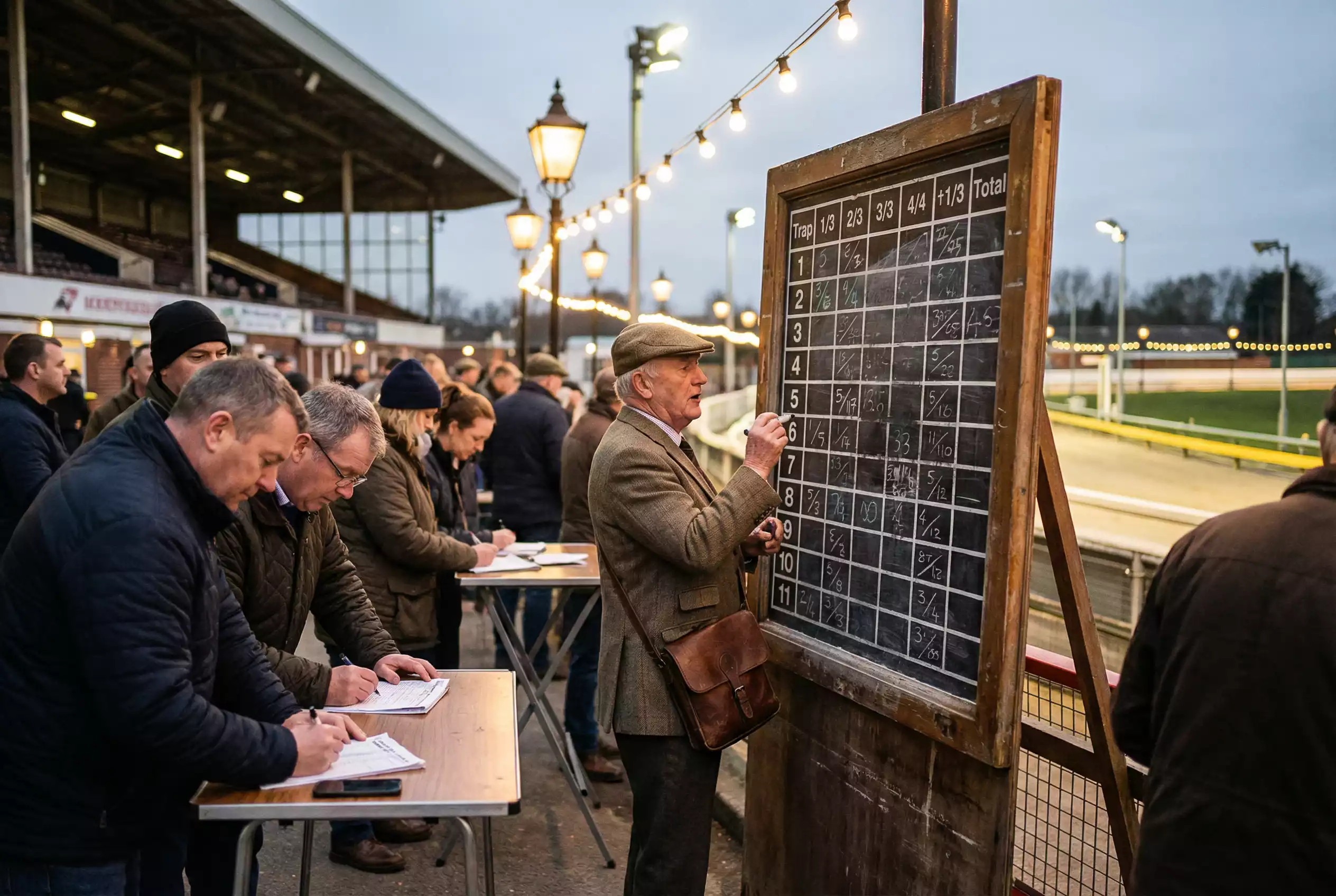
Trap Challenge: Here you select a single trap number and back it to produce the most winners across a meeting or a sequence of races. If Trap 3 wins three times and no other trap manages more than two, Trap 3 pays out. This bet rewards knowledge of track-specific bias and the grading policy of that evening’s card. A meeting stacked with fast middle seeds in Trap 3 changes the odds significantly compared to one where wide runners dominate.
Trap-specific markets suit bettors who prefer macro-level analysis over detailed dog-by-dog form. They also serve as useful hedges or side bets to complement traditional wagers on individual races.
Key Takeaway
Greyhound betting markets range from the straightforward win single to multi-race pools and trap-focused wagers. Each market carries its own risk profile and its own connection to trap statistics. Understanding the full menu allows you to match your angle—whether that is form analysis, track bias, or pure statistical play—to the bet type that best exploits it. Know your markets before you place your bets, and the sport becomes considerably more navigable.
