
Introduction
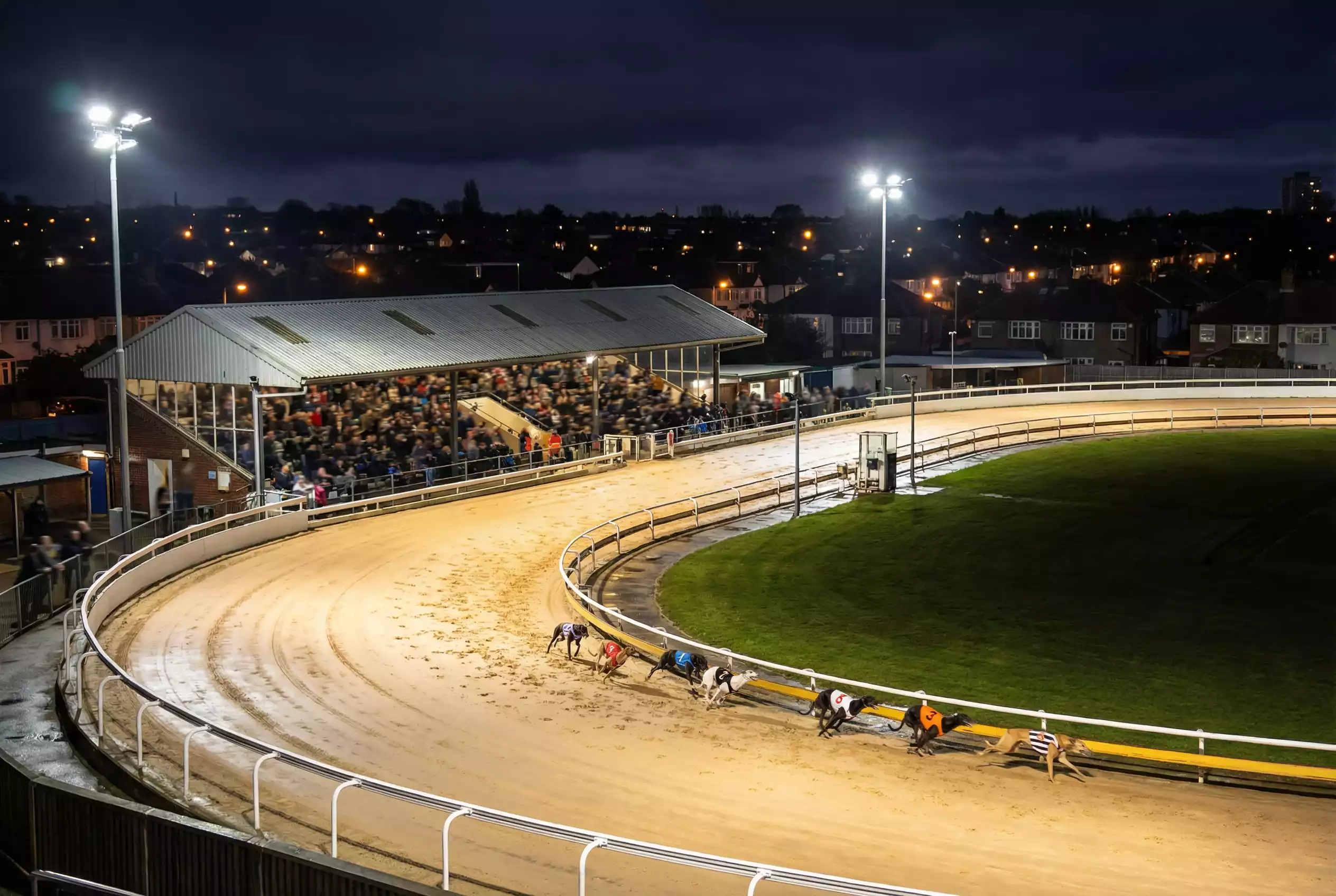
Romford Greyhound Stadium stands as the flagship venue for licensed racing in the United Kingdom. Located in Essex on the eastern edge of London, it hosts evening meetings that draw strong crowds and generate deep betting markets. For punters studying UK greyhound racing, Romford is unavoidable—its results shape betting patterns nationally, and its trap statistics provide benchmarks against which other tracks are measured. If you only know one track, Romford is the one to know.
Essex’s premier track where trap 3 rules. That description captures Romford’s defining characteristic. The middle trap has delivered exceptional results over extended periods, outperforming theoretical probability by a margin that demands explanation. Understanding why Trap 3 dominates at Romford is essential for anyone betting seriously on the track, and the reasons reveal broader truths about how track geometry shapes racing outcomes.
Why the middle box wins so often is in trap 3.
Track Specifications
Romford operates a standard oval configuration with sand-based surface. The track offers racing over multiple distances, with 400 metres being the primary trip and 250 metres serving sprint events. The circumference and bend geometry create tight turns that influence trap dynamics significantly.
The bends are sharper than at some larger circuits, which rewards dogs that hold inside lines and penalises those that drift wide. This geometry is one reason why inside and middle traps tend to outperform at Romford. A dog that swings wide on the bends covers noticeably more ground than one that hugs the rail or runs a compact middle line.
Surface quality is maintained to GBGB standards, with regular inspections ensuring consistent going. Romford’s location in the relatively dry southeast means it faces fewer wet-weather meetings than northern tracks, producing more reliable form patterns. When rain does arrive, the track drains adequately but still shows the typical shift toward inside bias that affects all sand surfaces.
Facilities have been updated over the years to serve both trackside attendance and broadcast requirements. Evening meetings are televised widely, reaching betting shops and online audiences across the country. This visibility means Romford results influence punters who never visit the track in person—the market is national even though the racing is local.
The kennelling and paddock areas meet modern welfare standards. Dogs racing at Romford are housed in on-site facilities before their events, and veterinary oversight is present throughout meetings. The professionalism of the operation reflects Romford’s status as a leading venue.
Trap Statistics
Romford’s trap statistics tell a clear story: Trap 3 dominates. Over a seven-week sample tracked by betting analysis, Trap 3 produced 28 wins from 98 races—a win rate of 28.5%. Twenty-five of those wins came in the final five weeks of the sample, suggesting a streak rather than a temporary blip. While shorter samples carry variance, the Trap 3 advantage at Romford is well established over longer periods as well, confirmed by years of data rather than weeks. As GBGB Commercial Director Mark Moisley has observed about the sport’s competitive standing: “Horse racing has more injuries per race and more fatalities per race than we do.” That comparison reflects the professionalism of venues like Romford.
Why does Trap 3 perform so well? The answer combines track geometry with seeding patterns. Romford’s tight bends favour dogs that can hold a compact line without drifting wide. Trap 3, positioned in the middle, allows dogs to cut inside if space appears while avoiding the immediate crowding that Trap 1 sometimes faces. Middle runners seeded into Trap 3 tend to be versatile dogs with good tactical awareness—qualities that translate to wins on a track that punishes one-dimensional running styles.
Trap 1 performs respectably, benefiting from rail proximity on a track where the inside line is efficient. However, crowding at the first bend can cost Trap 1 dogs valuable early position. A slow break from Trap 1 at Romford often results in trouble, while a slow break from Trap 3 is easier to recover from. The rail advantage exists but is not as clean as at tracks like Towcester where inside dominance is even more pronounced.
Trap 2 occupies middle ground, neither outstanding nor poor. Its performance tends to reflect the quality of dogs drawn there rather than positional advantage. Trap 4 similarly shows neutral results, serving as a transition zone between the favoured middle and the struggling outside.
Outside traps struggle relative to their theoretical expectation. Trap 6 rarely dominates Romford meetings, and punters who back wide runners need strong reasons beyond position to justify the selection. The geometry simply does not suit dogs who prefer to run around rivals. Trap 5 fares slightly better but remains below average. Wide seeds at Romford face an uphill battle that form alone may not overcome.
Favourite win rates at Romford sit around the national average, reflecting the competitive grading and deep racing population. The track does not produce an unusual number of upsets, but nor does it guarantee that market leaders convert. Trap position adds a layer of uncertainty that even strong favourites cannot fully overcome.
The wider context is set out in our guide to UK greyhound traps.
Racing Calendar
Romford races primarily on weekday evenings, with meetings typically beginning in the early evening and running through ten to twelve races. The schedule is consistent, providing regular opportunities for punters who specialise in the track. Weekend meetings occur but are less frequent than the weekday staples. This predictability is valuable for serious bettors who want to build expertise in one venue.
Major events punctuate the calendar. Open races and invitation events draw top dogs from across the country, elevating the quality of competition above standard graded cards. These occasions attract increased betting interest and larger crowds, though the altered field composition can disrupt normal trap patterns. Dogs unfamiliar with Romford may not replicate their home-track form, adding uncertainty to these premium events.
Seasonal variation is minimal compared to northern tracks. Romford rarely loses meetings to weather, and the southeast climate produces consistent conditions through most of the year. Winter evenings may see slightly smaller crowds, but the racing continues uninterrupted. Summer offers longer daylight and more pleasant trackside conditions, though the televised product looks the same regardless of season.
For punters, the consistency is valuable. Romford’s regular schedule allows for sustained form study without the interruptions that plague tracks in harsher climates. Dogs running repeatedly at Romford build track-specific form that aids analysis, and patterns emerge over time that reward patient observation.
Key Takeaway
Romford is the UK’s premier greyhound track, combining deep betting markets with consistent racing quality. Essex’s premier track where trap 3 rules—that statistic is not a quirk but a structural feature of the venue’s geometry and seeding patterns. Punters betting on Romford should weight Trap 3 performance heavily, approach outside traps with caution, and recognise that the track’s visibility makes its markets sharper than those at less-followed venues. Romford rewards form study and trap analysis; it does not reward guesswork.
