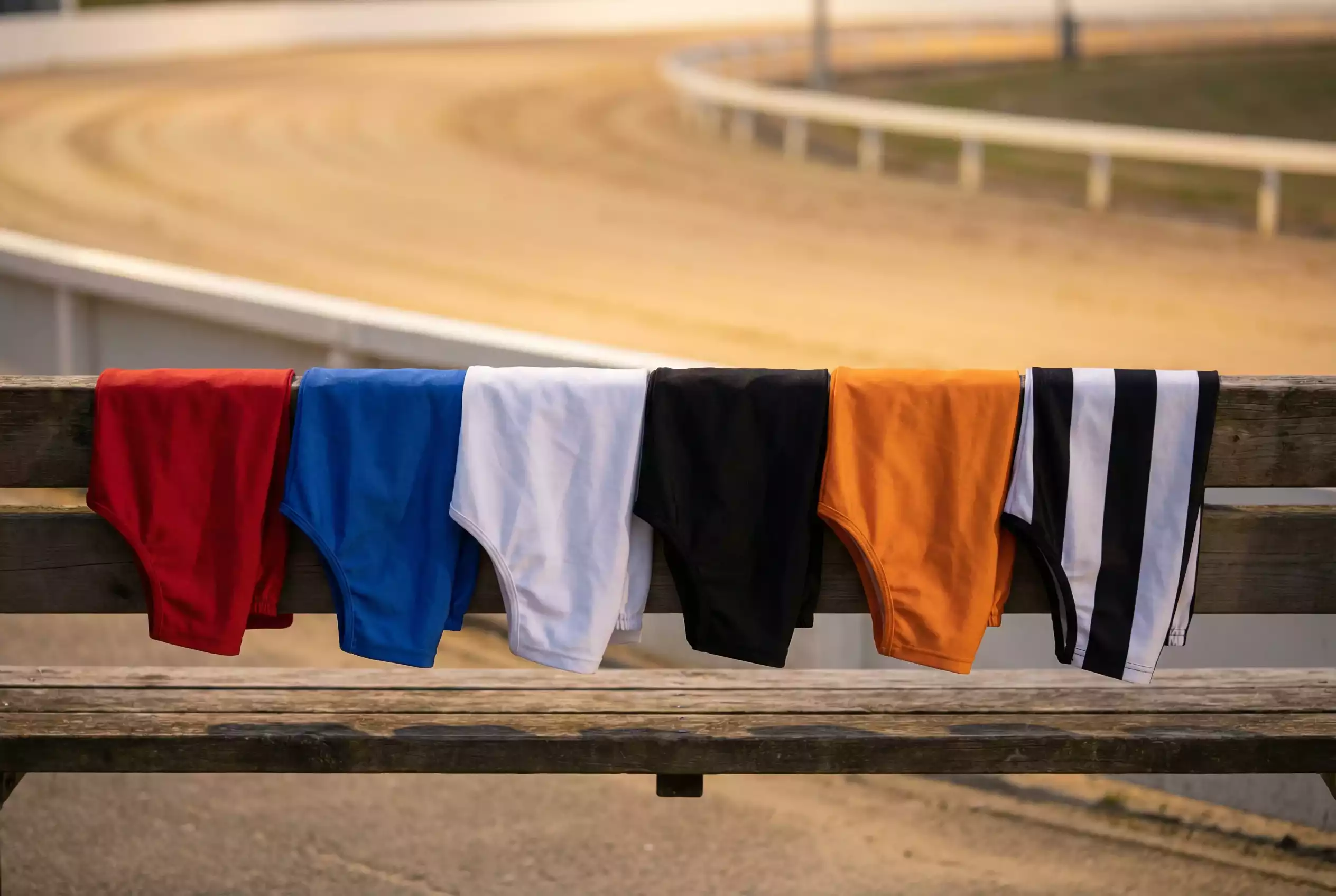
Walk into any UK greyhound stadium and you will see six dogs wearing six different coloured jackets. These colours are not decorative choices or trainer preferences. They are standardised identifiers that tell you exactly which trap each dog will break from. Colours that tell you everything at a glance.
The jacket colour system has been part of British greyhound racing for decades, providing spectators and punters with instant visual identification during the chaos of a race. When six dogs sprint at speeds exceeding 40 miles per hour around tight bends, distinguishing between them would be nearly impossible without clear colour coding. The system works because it never changes: trap 1 always wears red, trap 6 always wears black and white stripes.
Understanding these colours is fundamental for anyone watching or betting on greyhound racing. This guide explains each of the six standard UK colours and how they compare to systems used in other countries.
Where the colours appear is on the race card.
The Six Standard Colours
UK greyhound racing uses six standardised jacket colours corresponding to traps 1 through 6. These colours apply at all GBGB-licensed stadiums, ensuring consistency whether you are watching at Romford, Towcester, or any other venue. The system eliminates confusion and allows punters to track their selections throughout the race.
Trap 1: Red
The red jacket occupies the inside position, closest to the rail. Dogs breaking from trap 1 have the shortest path around the track, making this position geometrically advantageous on most circuits. Railers—dogs seeded for inside running—typically receive trap 1 allocations. The red jacket is immediately visible against the track surface and stands out during the critical first bend where positions are established. At venues with pronounced inside bias like Towcester, the red jacket wins approximately 20% of races.
Trap 2: Blue
Blue indicates trap 2, the second inside position. Dogs here share some of the rail advantage with trap 1 while having slightly more room to manoeuvre at the break. Blue jackets often go to railers or middle runners, depending on the race composition. The colour contrasts well with the red of trap 1, making it easy to distinguish between the two inside dogs during close racing.
Trap 3: White
The white jacket marks trap 3, the central inside position. This trap shows elevated win rates nationally—often exceeding 18%—partly because it receives middle-seeded dogs with tactical flexibility. The white jacket becomes a focal point for punters who know that trap 3 statistically outperforms theoretical probability at most venues. White stands out clearly during both daylight and evening racing under floodlights.
Trap 4: Black
Black designates trap 4, the central outside position. Middle runners and some wide runners occupy this trap, which offers options to run either inside or outside depending on how the race unfolds. The black jacket can be harder to track on darker surfaces, but modern stadium lighting ensures visibility remains adequate for identification.
Trap 5: Orange
Orange signals trap 5, the second outside position. Wide runners seeded to the outside traps often appear here, though middle runners may also receive trap 5 allocations. The orange colour provides strong visual contrast against the track and other jackets, making it one of the easier colours to follow during fast-moving action.
Trap 6: Black and White Stripes
The distinctive black and white striped jacket belongs to trap 6, the outside position. Dogs here have no runner to their outside, giving them clear space to swing wide without interference. At venues like Harlow where trap 6 wins 21% of races, the stripes become associated with genuine advantage rather than the traditional assumption that outside means disadvantage. The striped pattern ensures immediate recognition even in poor viewing conditions.
Why Colours Matter for Betting
These six colours have become embedded in greyhound racing culture. Punters refer to backing “the red jacket” or watching “the stripes” rather than citing trap numbers. The visual shorthand speeds communication and enhances the spectator experience. During live racing, the ability to instantly identify your selection by colour rather than searching for a number improves engagement and reduces the frustration of losing track during crowded racing.
The colour system also aids race replays and video analysis. When reviewing footage to assess running styles or identify interference, colours provide clearer tracking than numbers alone. Punters studying form through replays benefit from the same instant identification that serves live spectators.
The wider context is set out in our guide to UK greyhound traps.
International Colour Variations
The UK system is not universal. Other greyhound racing nations use different colour schemes, which can confuse punters accustomed to one system when watching or betting on racing from abroad. Understanding these variations matters for anyone following international greyhound racing.
Australian greyhound racing uses a different colour sequence. While some colours overlap with the UK system, the trap assignments differ. Australian trap 1 is red, matching the UK, but subsequent traps diverge. This means a punter familiar with UK colours cannot assume the same meanings apply when watching an Australian meeting. The visual identification remains consistent within each country’s system, but translating between systems requires attention.
American greyhound racing—where it still operates—follows yet another colour scheme. The US system evolved independently from both UK and Australian traditions, resulting in a third distinct sequence. With American greyhound racing having declined significantly, fewer UK punters encounter this system, but historical footage and any remaining racing show different colour conventions.
Irish greyhound racing largely mirrors the UK system, reflecting shared sporting heritage. Dogs racing at Irish venues wear the same colours for the same traps, making cross-border racing straightforward for punters. The consistency extends to rules and seeding practices, creating a unified approach across Britain and Ireland despite separate regulatory structures.
The historical origins of the colour systems trace back to the early decades of organised greyhound racing. By 1927, the sport had expanded to 40 tracks across the UK, with the sport’s popularity peaking in 1946 when post-WW2 jubilation lured 70 million attendees to the tracks. The colour coding developed during this era became standardised as the sport professionalised, ensuring that the visual identification system created nearly a century ago still serves punters today.
For punters betting internationally through online platforms, awareness of colour differences prevents confusion. A red jacket in Australia means the same trap 1 as in the UK, but beyond that position, assumptions break down. Checking each jurisdiction’s colour code before betting on unfamiliar racing ensures you are tracking the correct dog throughout the race.
Key Takeaway
The six standardised jacket colours—red, blue, white, black, orange, and black-and-white stripes—provide instant trap identification at every GBGB stadium. Red always means trap 1, stripes always mean trap 6. This consistency allows punters to track their selections during racing and communicate using colour shorthand rather than trap numbers.
International systems differ, so UK colour assumptions do not apply to Australian or American racing. Irish racing shares the UK colour conventions. The system developed during greyhound racing’s rapid expansion in the mid-twentieth century and has remained unchanged, proving its practical value through decades of use.
For newcomers to greyhound racing, learning the colour code is essential. Once memorised, the colours become automatic—you will never need to think about which trap wears which jacket. Colours that tell you everything at a glance remain fundamental to the sport, connecting today’s punters to a system established when the sport first professionalised.
