
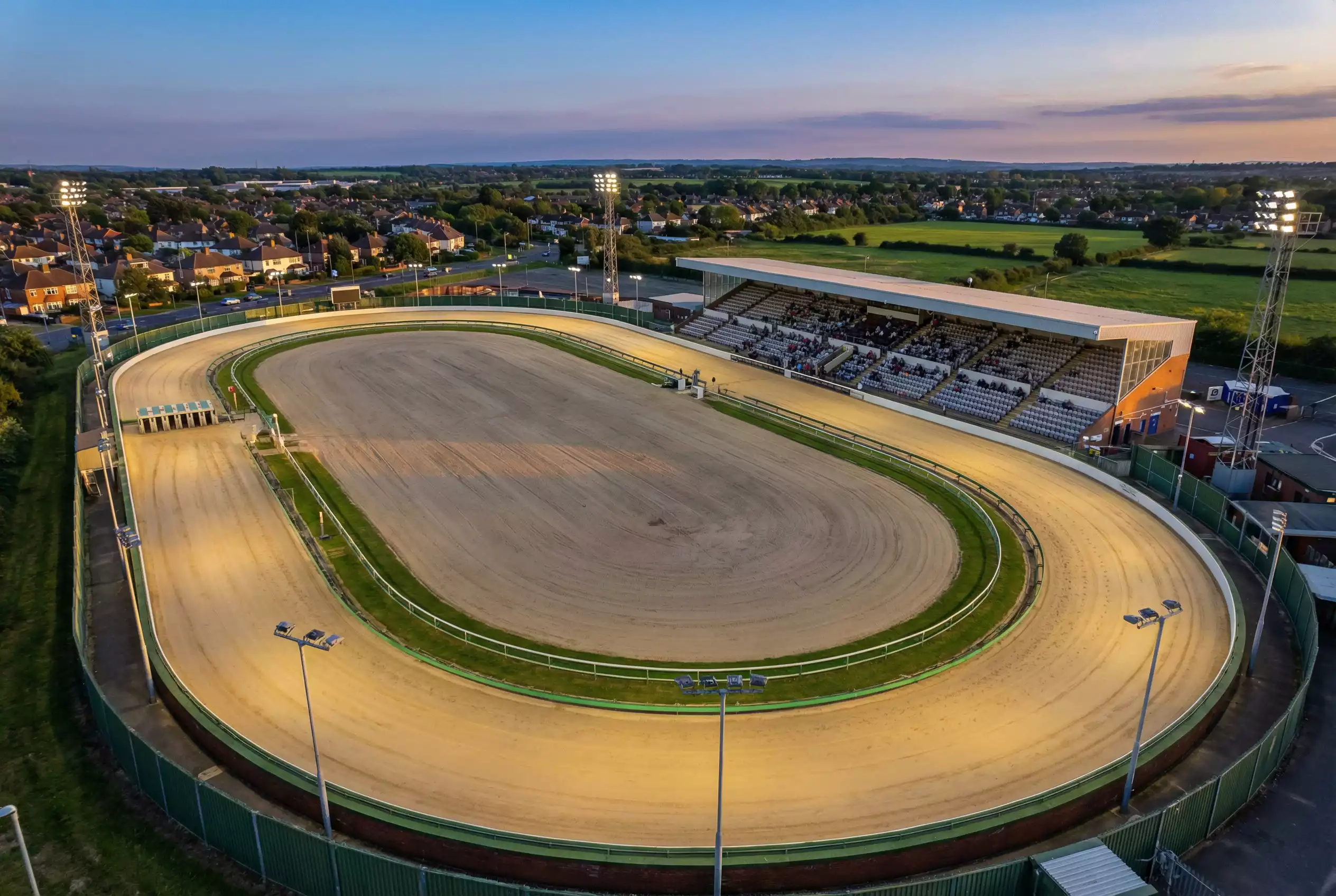
The United Kingdom operates eighteen GBGB-licensed greyhound stadiums as of January 2025, spread across England from the south coast to Yorkshire. Each track has distinct characteristics—circumference, surface, racing calendar, and trap bias—that create unique environments for racing and betting. Knowing the circuit helps you understand where the numbers come from and which venues suit your approach.
Every track has its own character—and its own numbers. Romford hosts more racing than most venues combined. Towcester’s trap 1 wins at rates that would seem impossible at Harlow, where trap 6 dominates instead. Some tracks produce predictable results where favourites win regularly; others generate chaos that frustrates systematic approaches. Understanding these differences transforms the circuit from a list of names into a map of opportunities.
This guide profiles UK greyhound tracks by region, covering key characteristics that affect trap performance and betting dynamics. Whether you attend meetings in person, watch televised racing, or follow results online, knowing the venues expands your handicapping toolkit. Some punters specialise in particular tracks, developing deep knowledge that casual observers can’t match. Others follow the circuit broadly, applying general principles across multiple venues. Either approach benefits from understanding what makes each track distinctive.
The circuit has evolved substantially. Stadium closures and openings reshape the landscape; regulatory changes affect where and how racing operates. The 2026 profile of UK greyhound racing differs from even recent years, and the trends suggest continued evolution ahead.
The win rates at each are in the trap statistics.
London and South East
The London area and South East host the highest concentration of greyhound racing activity in the UK. Multiple venues operate within easy reach of the capital, serving both the casual entertainment market and dedicated punters who follow racing seriously. The region’s tracks range from historic stadiums with decades of racing history to modern facilities adapted from other uses.
Romford stands as one of the busiest tracks in British greyhound racing. Operating multiple meetings weekly, Romford produces more racing data than most venues, making its trap statistics particularly robust. Trap 3 has historically shown exceptional performance at Romford, with documented periods of extended dominance. The track’s high volume attracts trainers seeking regular racing opportunities, creating competitive fields across graded events.
Harlow demonstrates the most pronounced outside bias in UK racing, with trap 6 winning at approximately 21%—nearly five percentage points above the national average. The track’s geometry favours wide runners who can hold their line to the first bend without losing excessive ground. Punters following Harlow should weight outside positions more heavily than general statistics would suggest; the structural advantage is real and persistent.
Central Park (formerly Sittingbourne) operates in Kent, providing racing for the southeastern region outside the immediate London area. The track offers a mix of distances and maintains a regular racing calendar. Its trap statistics fall closer to national averages than Romford or Harlow, making it a venue where form and grading matter more than trap-based systems.
Brighton and Hove, located on the south coast, operates a smaller circumference track that produces tighter racing. First-bend positioning determines most outcomes, amplifying the importance of trap position. Inside traps benefit from the compact layout; outside traps face crowding risks that accumulate with multiple runners targeting similar racing lines. The track’s seaside location creates variable weather conditions that affect surface quality seasonally.
Crayford, which closed in January 2025, was historically significant as the UK’s last track offering hurdle racing alongside flat events. Its closure ends a racing format that distinguished British greyhound racing from circuits elsewhere. The flat-race statistics from Crayford showed moderate inside bias consistent with its track dimensions. Dogs previously racing at Crayford have redistributed to other southeastern venues.
The southeastern region’s density creates opportunities for punters who can attend multiple venues or follow televised racing from the area. Dogs often race across several tracks in the region, building form profiles that span different track characteristics. A dog that performs well at Romford may show different patterns at Harlow or Brighton, depending on whether its running style aligns with each venue’s bias.
Transport links make southeastern tracks accessible for live attendance. London-based punters can reach multiple venues on public transport, while good road connections serve those driving from further afield. This accessibility contributes to larger crowds and more liquid betting markets compared to tracks in less connected regions.
Midlands
The Midlands hosts several significant greyhound tracks serving the region’s substantial population. These venues tend to show more balanced trap statistics than their southeastern counterparts, with bias patterns that cluster closer to the expected 16.67% per trap. For punters, Midlands racing rewards comprehensive form analysis over single-factor approaches based on trap position.
Monmore Green, located in Wolverhampton, ranks among the most established Midlands venues. The track operates a full racing calendar with graded events that attract quality fields. Its trap statistics show relatively even distribution, indicating geometry that doesn’t strongly favour inside or outside positions. Dogs racing at Monmore succeed or fail primarily on merit rather than draw advantage.
Perry Barr in Birmingham has operated greyhound racing since 1928, making it one of the oldest continuously operating tracks in the country. Its historical inside bias has moderated over time as maintenance practices evolved. Changes in sand depth, drainage improvements, and rail adjustments have produced more balanced contemporary statistics while preserving the venue’s character.
Towcester, despite its Northamptonshire location sometimes being grouped with southeastern racing, shows characteristics distinct from London-area tracks. Its pronounced trap 1 bias—winning at approximately 20%—reflects track geometry that rewards early rail possession. Railers drawn to the red jacket benefit from a structural advantage that persists across seasons and different dog populations.
Dunstall Park represents the newest addition to the Midlands circuit, opening in September 2025. As a newly operational venue, its trap statistics remain provisional. Early-season results at new tracks are notoriously unreliable—dogs and trainers need time to learn the venue, and the racing office needs data to establish proper seeding patterns. Punters should treat Dunstall Park statistics cautiously until a full year of racing establishes baseline patterns.
The Midlands region serves as a training base for numerous kennels, creating a resident dog population that races primarily at regional tracks. This concentration affects the quality and consistency of racing—dogs racing regularly at familiar venues may perform differently when shipped to distant tracks. Punters following Midlands racing develop knowledge of local kennels and trainers that provides context beyond raw form figures.
Swindon, while geographically southwestern, shares characteristics with Midlands racing in its balanced trap performance. The track operates both standard distances and sprints, with distance-specific trap patterns that aggregate statistics may obscure. Sprint races amplify trap importance due to fewer bends; standard races allow more time for dogs to find position.
Coventry and Nottingham have historically contributed to Midlands racing, though the specific status of venues changes over time. The region’s population density supports multiple tracks within reasonable travel distance, creating a racing circuit where dogs compete across venues and punters can follow familiar runners at multiple locations. This regional integration affects how form translates between tracks—dogs adapting well to one Midlands venue often perform similarly at others with comparable characteristics.
The full picture is in our guide to UK greyhound traps.
North and Yorkshire
Northern England and Yorkshire host greyhound racing that operates somewhat independently from the southeastern circuit. Fewer tracks serve a large geographic area, creating racing communities centred on particular venues. The northern tracks show distinctive characteristics in trap performance and betting predictability that differ from southern patterns.
Kinsley recorded the lowest favourite win rate of any UK track in 2024 at 31.60%. This unpredictability makes the venue challenging for systematic bettors—when race outcomes are fundamentally less predictable, any single factor including trap position carries less weight. Kinsley rewards intuitive handicapping and acceptance of variance over mechanical approaches.
The Valley, operating in Wales but serving northern and western racing audiences, recorded the highest favourite win rate at 42%. This predictability creates conditions where trap bias expresses itself more cleanly. When races generally go to form, underlying patterns show their effects more reliably. The contrast with Kinsley—located relatively nearby—illustrates how dramatically betting conditions can differ between venues.
Newcastle provides racing for the northeast, serving a population centre that would otherwise lack convenient access to greyhound events. The track’s isolation from other venues means dogs racing there compete primarily against local populations rather than runners shipped from distant kennels. This creates form patterns that may not transfer to other tracks and require venue-specific evaluation.
Sheffield’s closure in 2023 removed a significant northern venue from the circuit. Dogs previously racing at Sheffield redistributed to remaining tracks, affecting competitive dynamics at receiving venues. The closure also ended a track that had shown pronounced seasonal variation in trap bias, with winter racing producing stronger inside patterns than summer cards.
Belle Vue in Manchester holds historical significance as the site of Britain’s first modern greyhound race in 1926. The track’s centenary celebrations in 2025 marked a hundred years since organised greyhound racing began in the UK. Contemporary Belle Vue statistics show moderate inside bias consistent with its track layout, though not as pronounced as Towcester or some southeastern venues.
Northern tracks operate with fewer meetings per week than high-volume southeastern venues, producing smaller statistical samples that require more caution in interpretation. Trap bias patterns at lower-volume tracks may take longer to establish and show more variance around true values. Punters specialising in northern racing need patience as patterns emerge more slowly than at venues like Romford.
Weather affects northern tracks more consistently than southern venues. Longer winters, more frequent rainfall, and lower temperatures produce surface conditions that favour inside running for extended periods. Seasonal analysis is particularly important for northern tracks where weather patterns persist across weeks rather than varying day to day.
Scotland and Periphery
Scotland’s relationship with greyhound racing has changed dramatically. Thornton, the last Scottish track, closed in March 2025. According to reports from Kinship, Scottish legislation to ban greyhound racing has reached Stage 1 in the parliamentary process, reflecting broader regulatory pressure on the sport in that nation.
The loss of Scottish racing removes the sport from an entire nation of the United Kingdom. Dogs that previously raced in Scotland now compete at northern English tracks or have retired from racing entirely. For punters who followed Scottish venues, the closure redirects attention southward to tracks that remain operational.
Wales faces similar regulatory pressure. The Welsh Senedd introduced legislation to ban greyhound racing, with implementation scheduled for 2027. The Valley currently operates as the primary Welsh venue, serving both local racing enthusiasts and punters following televised events. Its high favourite win rate (42%) makes it attractive for systematic bettors, but the regulatory timeline suggests limited remaining operational years.
Northern Ireland operates outside the GBGB framework, with separate governance under Irish greyhound racing structures. Tracks in Northern Ireland follow different rules and produce statistics that don’t integrate directly with GBGB data. Punters following UK racing should treat Northern Irish events as a distinct racing environment rather than an extension of the British circuit.
The contraction of the racing map has concentrated activity in England. Eighteen GBGB-licensed tracks now operate entirely within English borders, with The Valley in Wales representing the only current exception. This concentration affects dog populations, trainer logistics, and the economics of racing operations. Tracks that remain operational benefit from reduced competition for dogs and punters, while venues near the geographic periphery face challenges serving dispersed audiences.
The regulatory environment continues to evolve. Welfare organisations have increased pressure on the sport, leading to legislative action in Scotland and Wales. England has not followed this path—the GBGB’s welfare improvements have helped maintain government support for licensed racing. However, the trajectory in other UK nations suggests that the regulatory landscape could shift further, affecting where greyhound racing operates in future years.
Recent Openings and Closures
The UK greyhound racing landscape has experienced significant changes in recent years, with track closures outpacing new openings. Understanding these shifts helps punters contextualise historical statistics and anticipate how the circuit may evolve.
Dunstall Park opened on 19 September 2025, providing the circuit’s most recent new venue. Located in the Midlands, the track adds capacity to a region that had seen stable or declining racing opportunities. Early-season statistics from Dunstall Park should be treated as provisional—new tracks require time to establish trap patterns as dogs and trainers adapt to unfamiliar geometry and surfaces.
Crayford closed on 19 January 2025, ending operations at the UK’s last venue offering hurdle racing. According to records from 2025, the closure removed a distinctive racing format from British greyhound racing. Dogs previously running at Crayford redistributed to other southeastern tracks, temporarily affecting competitive dynamics at receiving venues.
“We are delighted to share the latest progress report on GBGB’s long-term welfare strategy,” noted Tiffany Blackett, Executive Veterinarian at the GBGB, reflecting the organisation’s focus on welfare standards across remaining venues rather than circuit expansion.
Sheffield’s 2023 closure removed a significant northern venue that had shown pronounced seasonal trap bias. The dogs and racing community that centred on Sheffield dispersed to remaining northern tracks, changing competitive fields at those venues. Punters who had developed Sheffield-specific expertise lost a venue while potentially gaining transferable knowledge about northern racing patterns.
The overall trajectory shows contraction rather than growth. From 77 licensed tracks in the 1940s to 18 today, UK greyhound racing has consolidated dramatically. This long-term decline reflects changing entertainment preferences, urban development pressures on stadium sites, and regulatory challenges that have intensified in recent years.
Track changes affect trap statistics in ways that punters must account for. Historical data from closed tracks becomes purely archival. Statistics from recently opened tracks remain provisional until sufficient races establish reliable patterns. Redistributed dog populations can shift competitive dynamics at receiving venues, temporarily distorting the trap statistics that reflect normal operations.
Punters following greyhound racing long-term should monitor announcements about track operations. Closures typically follow periods of declining attendance or commercial challenges; new openings require substantial investment and regulatory approval. The current circuit represents a snapshot that will continue evolving.
Choosing a Track to Follow
Specialising in particular tracks offers advantages that following the entire circuit cannot match. Deep knowledge of a single venue—its trap bias, trainer patterns, grading tendencies, and seasonal variations—provides context that casual followers lack. The choice of which track to follow should reflect your circumstances, interests, and betting approach.
High-volume tracks like Romford provide abundant data for statistical analysis. Frequent racing means trap patterns establish quickly and sample sizes support confident conclusions. Punters using quantitative approaches benefit from venues where numbers accumulate fast enough to distinguish signal from noise.
High-favourite tracks like The Valley suit systematic bettors who want races to go to form. When outcomes are predictable, underlying factors express themselves more cleanly. Trap bias, form analysis, and grading assessment all prove more reliable when the competitive field behaves as expected.
Pronounced bias tracks like Harlow or Towcester reward trap-focused approaches. The structural advantages at these venues are real and persistent—punters who incorporate bias correctly gain edges that generic analysis misses. Specialising in a venue with strong bias lets you exploit that advantage repeatedly.
Local tracks make sense for punters who can attend meetings. Live observation reveals information that form figures and statistics miss—how dogs behave in the paddock, how trainers prepare their runners, how surface conditions actually look on the night. This ground-level intelligence supplements data-driven analysis.
Televised tracks reach wider audiences but attract more betting competition. Markets at well-covered venues are more efficient; finding value requires sharper analysis than at tracks with less attention. The trade-off between information access and betting efficiency favours different venues for different punters.
Whatever track you choose, consistency matters. Developing expertise takes time and repeated observation. Jumping between venues prevents the deep knowledge that specialists accumulate. Pick a track that fits your circumstances and commit to learning it thoroughly.
Key Takeaway
The eighteen GBGB-licensed tracks operating in 2026 represent a consolidated circuit with distinct regional characteristics. Southeastern tracks like Romford, Harlow, and Central Park offer high-volume racing with pronounced bias patterns. Midlands venues including Monmore Green, Perry Barr, and the newly opened Dunstall Park show more balanced statistics. Northern tracks serve dispersed populations with racing that rewards venue-specific knowledge.
The circuit continues to evolve. Crayford’s January 2025 closure ended hurdle racing in the UK. Scottish racing has ceased entirely with legislation advancing towards a formal ban. Wales faces similar regulatory pressure with a 2027 ban scheduled. The concentration of racing in England reshapes competitive dynamics and affects dog populations across remaining venues.
Every track has its own character—and its own numbers. Whether you specialise in one venue or follow the circuit broadly, understanding what makes each track distinctive helps you interpret the statistics that inform selections. The map of UK greyhound racing isn’t static; knowing where it’s been and where it’s heading provides context that pure numbers cannot.
