
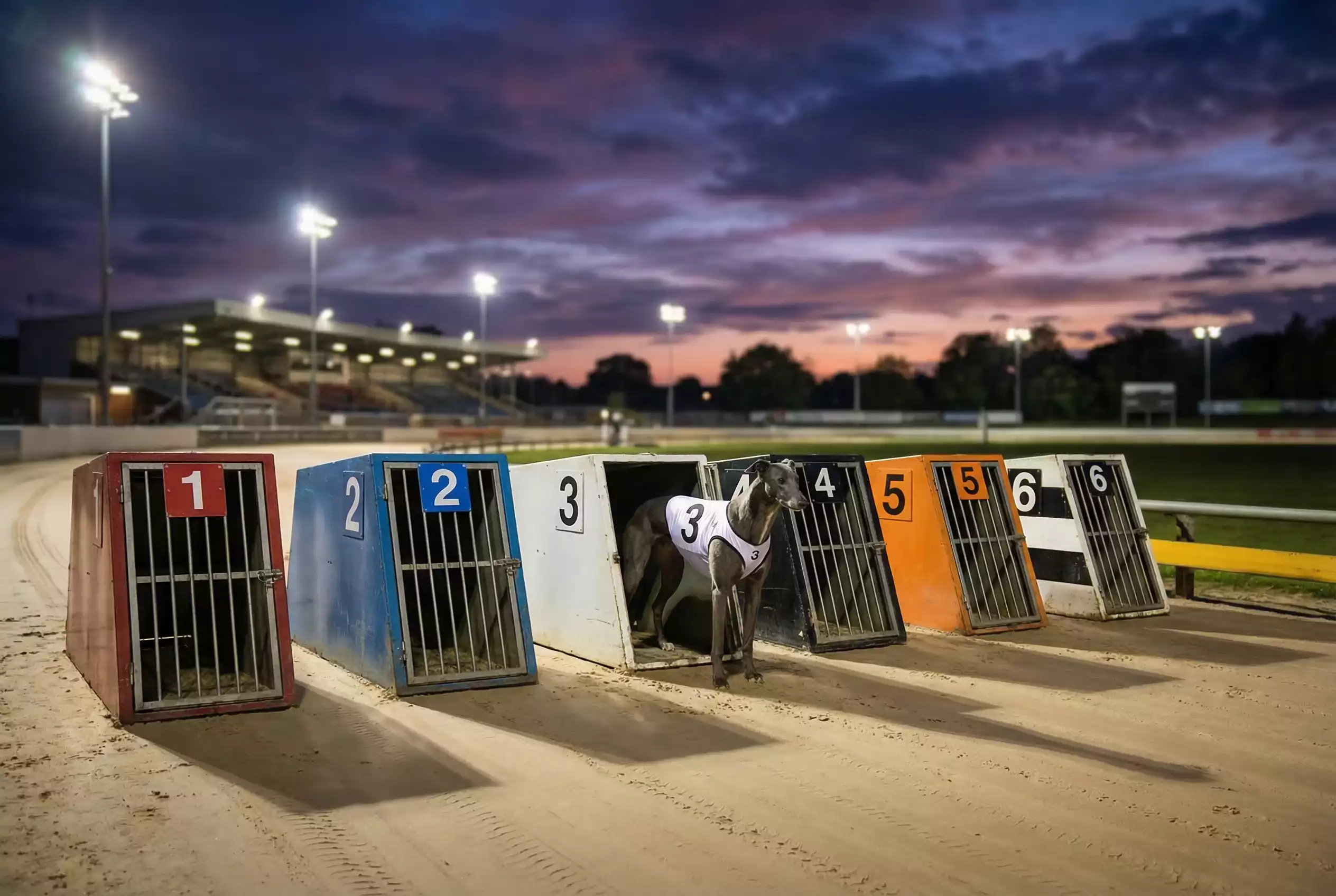
Every greyhound punter eventually asks the same question: which trap wins most? The answer depends entirely on where you’re watching. Greyhound trap statistics vary dramatically across UK tracks, shaped by track geometry, surface conditions, and the seeding system that allocates dogs to their starting positions. What works at Romford may fail at Towcester. What dominates at Harlow might underperform at Monmore.
The numbers behind every trap tell a story that theoretical probability cannot capture. In a perfect world, each of the six traps would win exactly 16.67% of races. Reality operates differently. Some traps consistently outperform their expected share; others lag behind year after year, regardless of which dogs occupy them. Understanding these patterns requires looking beyond headline statistics to the mechanical and environmental factors that create them.
This analysis draws on data from the GBGB’s 2024 racing statistics, which recorded 355,682 races across all licensed tracks. That sample size matters. Individual track sessions or weekly results can swing wildly due to small numbers; annual aggregates reveal the underlying biases that persist over time. The following breakdown covers national averages, track-specific anomalies, and the practical implications for anyone using trap data to inform their selections. Whether you follow a single venue or watch racing from multiple stadiums, knowing where the numbers come from—and what they actually mean—gives you an edge that casual observation cannot provide.
Why the numbers differ by venue is in track bias.
National Trap Win Averages
Across all eighteen GBGB-licensed stadiums, trap win rates cluster around the theoretical 16.67% mark—but not evenly. According to analysis published by Oxford Stadium, trap 3 averages above 18% nationally, making it the most successful starting position in UK greyhound racing. This two-percentage-point deviation from expected probability translates into real returns over thousands of races.
The middle traps—positions 3 and 4—benefit from what racing insiders call positional flexibility. Dogs in these boxes can rail or run wide depending on how the break unfolds, adjusting their route to avoid trouble at the first bend. Traps 1 and 2 are committed to the inside line; traps 5 and 6 must negotiate wider paths to the first turn. The middle offers options, and options translate into fewer bad trips.
Trap 1 performs strongly at venues where the run to the first bend favours inside runners. Dogs breaking cleanly from the red jacket can establish rail position immediately, covering the shortest distance to the turn. At tracks with longer run-ups or tighter first bends, this advantage diminishes. The dog in trap 1 may lead into the turn only to face crowding from runners on their outside who push them towards the rail. National averages for trap 1 hover around the expected 16-17%, masking significant track-by-track variation.
Trap 6, the striped jacket, presents the opposite picture. Wide runners face the longest path to the first turn but escape the crowding that traps 1-4 encounter when multiple dogs target the same racing line. At certain tracks, this trade-off favours the outside; at others, the extra ground proves too costly. National averages place trap 6 slightly below expected win rate, yet individual venues show trap 6 outperforming all other boxes.
These averages matter most as reference points. A punter who knows that trap 3 nationally outperforms trap 6 by approximately two percentage points has context for evaluating track-specific data. When Harlow’s trap 6 hits 21% while the national average sits near 16%, that deviation signals something structural about the track rather than random variation. Without the baseline, the outlier is invisible.
Seasonal patterns also influence national figures. Winter racing on heavier, wetter surfaces tends to compress the field, favouring inside traps that don’t have to negotiate the damaged outside running line. Summer conditions—drier, faster—open up more racing room on the outside, allowing wide runners to make up ground. Annual statistics smooth these fluctuations into a single number, useful for broad orientation but insufficient for precise handicapping.
The seeding system shapes these averages in ways that casual observers often miss. GBGB regulations require racing offices to seed dogs according to their running styles: railers (R) go to inside traps, wide runners (W) to outside traps, and middle runners (M) to the central positions. This isn’t random allocation—it’s systematic matching of dog behaviour to trap position. The statistics that result reflect not just track geometry but the interaction between that geometry and the dogs most likely to occupy each position.
A railer drawn in trap 1 is seeded there precisely because it prefers the rail. That dog’s win rate from trap 1 reflects both the trap’s inherent advantages and the dog’s suitability for that position. Comparing trap 1’s win rate to trap 6’s without accounting for seeding confuses the picture. The dogs in those positions have different skill sets, making direct comparison misleading. What matters is whether a particular trap produces wins above what the seeded dogs’ form would suggest—and extracting that signal from the noise requires careful analysis.
Track-by-Track Breakdown
Individual tracks deviate from national averages in ways that reflect their physical characteristics. Data from OLBG’s 2025 statistics reveals pronounced biases that persist year after year. Towcester’s trap 1 wins at approximately 20%—well above the national baseline. Harlow’s trap 6 hits 21%, the highest outside-trap win rate in the country. These aren’t anomalies; they’re structural features of how each track operates.
Towcester’s inside bias stems from its track geometry. The run to the first bend is relatively short, and the bend itself favours dogs that establish rail position early. Railers seeded to trap 1 can break, hold the inside, and maintain that advantage through the entire race. Dogs in wider traps must either outpace the field to the first turn or accept running second or third around the bends. Over thousands of races, this configuration adds up to a measurable edge for the red jacket.
Harlow presents the inverse case. Its first bend opens up sufficiently for wide runners to hold their line without losing excessive ground. The track’s geometry gives trap 6 runners a cleaner path to the second bend, where they can apply pressure without facing the interference that plagues middle and inside positions at the first turn. Dogs seeded as wide runners benefit from this layout; the striped jacket outperforms its national average by nearly five percentage points.
Romford, one of the busiest tracks in the country, shows trap 3 dominance. Historical records indicate periods where trap 3 at Romford won 28 of 98 races—a 28.5% success rate nearly double the theoretical expectation. This pattern reflects the interaction between seeding, track layout, and the quality of dogs assigned to each position. Romford’s racing office seeds flexible middle-runners to trap 3, giving them the opportunity to exploit whatever racing room develops at the first bend.
Monmore Green and similar Midlands tracks demonstrate more balanced trap distributions. Their track geometries don’t strongly favour inside or outside positions, leading to win rates that cluster closer to the expected 16.67%. For bettors, balanced tracks require more attention to individual dog form and less reliance on trap-based systems. The numbers don’t hand you an edge; you have to find it in the formbook.
Perry Barr, another Midlands venue, historically showed a slight inside bias that has moderated over time as track maintenance practices evolved. Changes in sand depth, camber adjustments, and drainage improvements can shift trap performance over seasons. A track that favoured trap 1 three years ago might now show no significant bias. Static assumptions about track characteristics can cost you money.
Swindon operates a category 2 track that runs both standard distances and sprints. Distance affects trap bias. On shorter races, the first bend comes up quickly, amplifying the importance of trap draw. On longer races, dogs have more time to find their running positions, reducing the impact of starting position. Swindon’s overall trap statistics mask these distance-specific patterns; disaggregating by race length reveals sharper biases on sprint cards.
Newcastle and Kinsley represent the northern tracks where local conditions—weather, attendance patterns, dog populations—create their own statistical fingerprints. Kinsley recorded the lowest favourite win rate of any GBGB track in 2024, at 31.60%. This figure reflects competitive grading rather than trap bias, but it indicates the unpredictability that characterises racing at certain venues. Trap statistics at low-favourite tracks should be interpreted cautiously; when outcomes are harder to predict overall, any single factor’s influence becomes noisier.
Sheffield, prior to its 2023 closure, showed pronounced inside bias during winter months. Post-closure, the dogs that raced there dispersed to other northern tracks, potentially affecting those venues’ statistics as the population of runners shifted. Track closures and openings—Crayford closed in January 2025, Dunstall Park opened in September 2025—redistribute dogs and can temporarily distort the statistics at receiving venues until new equilibria establish.
Brighton and Hove, operating a smaller circumference track, produces tighter racing where first-bend positioning determines most outcomes. Inside traps benefit disproportionately; outside traps face crowding risks that accumulate with every runner targeting the same racing line. The statistics confirm this intuition: traps 1 and 2 outperform expected rates, while traps 5 and 6 lag behind.
Crayford, before its January 2025 closure, was the UK’s last track to offer hurdle racing alongside flat events. Its flat-race trap statistics showed moderate inside bias, consistent with its track dimensions. The hurdle races operated under different dynamics entirely, with trap position mattering less than jumping ability and stamina. Its closure removes a unique data point from the national picture.
The Valley, operating in Wales, recorded the highest favourite win rate of any UK track in 2024 at 42%. High favourite success rates suggest consistent grading and fewer surprise results—conditions where trap statistics may prove more reliable. When favourites win as expected, the underlying factors that predict outcomes (including trap position) express themselves more cleanly in the data. Low-variance tracks offer better environments for testing trap-based approaches.
Year-on-Year Trends
Trap statistics are not static. Year-on-year analysis reveals shifts in performance that reflect changes in track maintenance, racing calendars, and dog populations. A track that showed strong inside bias in 2023 might moderate that pattern in 2024 following surface improvements or changes to the running rail. Treating historical statistics as permanent features leads to stale assumptions.
The GBGB’s investment in track safety has direct statistical consequences. Track inspections by the Sports Turf Research Institute, now conducted four times annually per venue (doubled since 2022), have standardised surface quality across the licensed circuit. Better-maintained surfaces reduce the advantage that inside traps historically gained from avoiding chewed-up outside running lines. As track conditions converge, so do trap performance figures—though individual venue characteristics still produce measurable deviations.
The opening of Dunstall Park in September 2025 added a new track to the circuit with no historical statistical baseline. Early-season results at new venues are notoriously unreliable; dogs and trainers need time to learn the track, and the racing office needs data to establish proper seeding. Any trap statistics from Dunstall Park’s first months should be treated as provisional until at least a full year of racing establishes patterns.
Conversely, Crayford’s closure in January 2025 removed data from the national picture and redistributed its racing population. Dogs that previously ran at Crayford now appear at other southeastern tracks—Romford, Central Park, and Sittingbourne among them. This influx of new runners changes the competitive dynamics and can temporarily disrupt established trap patterns as the grading system absorbs the additional dogs.
Seasonal variation overlays these structural changes. Winter racing produces different trap statistics than summer racing at the same venue. Wet conditions, shorter daylight hours, and altered going surfaces all influence how races unfold. Annual statistics aggregate these seasonal differences into a single figure that may obscure significant within-year variation. Punters who specialise in seasonal conditions—winter specialists, for instance—may find that monthly or quarterly breakdowns offer more actionable insight than annual totals.
Long-term trends also reflect changes in breeding and training. The greyhound population evolves as certain bloodlines gain prominence and training methods adapt. A dog population dominated by early-pace specialists will produce different trap statistics than one featuring more stamina-oriented runners. These shifts occur gradually, over years rather than months, but they accumulate into detectable changes in how races are won.
Prize money distribution influences where trainers send their better dogs, which in turn affects the quality of competition at different venues. Tracks that attract higher-quality fields may show different trap patterns than those running weaker cards. When the same dog that dominated at one venue moves up in grade to another, the competitive dynamics shift. Annual statistics capture these effects implicitly, but understanding why the numbers move requires attention to the broader racing calendar.
The favourite win rate provides a useful secondary metric for evaluating trap statistics. In 2024, favourite win rates ranged from 31.60% at Kinsley to 42% at The Valley. Tracks with higher favourite win rates tend to show cleaner trap patterns—when races go to form, the underlying biases express themselves more reliably. At unpredictable venues like Kinsley, where upsets are common, trap statistics carry less weight. The chaos that disrupts favourite success also disrupts trap advantage.
The full picture is in our guide to UK greyhound traps.
How Sample Size Affects Statistics
The 355,682 races recorded across GBGB tracks in 2024 provide a dataset large enough to detect genuine patterns. That figure, drawn from the GBGB’s official racing data, breaks down to approximately 19,760 races per track annually—assuming even distribution, which doesn’t hold in practice. Larger tracks like Romford run more cards; smaller venues contribute fewer races to the total.
Statistical reliability scales with sample size. A track that runs 25,000 races per year produces trap statistics that stabilise faster than one running 12,000. When Harlow’s trap 6 shows a 21% win rate across a full year’s racing, that figure carries weight. When a smaller track shows similar deviation, more caution is warranted—the pattern might reflect chance rather than track characteristics.
Daily and weekly figures amplify this problem. A single race card might feature eight to twelve races, producing trap statistics that swing wildly from theoretical expectation. Trap 3 winning four of eight races on a Tuesday evening doesn’t indicate track bias; it indicates small-sample noise. Even monthly statistics at lower-volume tracks can mislead if interpreted as reliable indicators.
The practical implication for bettors is simple: use annual statistics as your baseline, seasonal statistics for refinement, and treat anything shorter than a month with scepticism. A trap-based system that relies on last week’s results will chase noise rather than signal. The patterns that persist across thousands of races are the ones worth incorporating into your selections.
Sample size also affects how quickly you can detect real changes. If a track modifies its running rail or resurfaces before a new season, the old statistics become partially obsolete. But detecting whether new patterns have emerged requires accumulating enough post-change races to distinguish signal from variance. The first few hundred races after a significant track change tell you almost nothing reliable; the first few thousand start to reveal what’s actually different.
Using Stats for Betting
Trap statistics inform betting decisions, but they don’t make them. Knowing that Towcester’s trap 1 wins at 20% tells you something real about the track; it doesn’t tell you whether today’s trap 1 runner deserves your money. The statistics provide context that must be combined with form, grading, and race conditions to produce selections with positive expected value.
The most direct application is identifying tracks where trap bias is strong enough to override other factors. At venues showing five-percentage-point deviations from expected win rates, trap position becomes a genuine handicapping factor rather than background noise. A dog with middling form drawn in a high-performing trap deserves consideration against a better-form rival drawn unfavourably. The trap bias functions as a tailwind for one runner and a headwind for another.
Odds adjustments follow from trap knowledge. Bookmakers price greyhound markets using form, grading, and kennel reputation as primary inputs. Track-specific trap bias is incorporated less consistently. At tracks where public data clearly shows significant deviation—Harlow’s trap 6, Towcester’s trap 1—the market may already have adjusted. At smaller venues or in less-publicised races, inefficiencies may persist.
Trap challenge betting offers a structured way to exploit bias. This market type asks you to select one trap number to win across multiple races at the same meeting. If trap 3 at a given venue shows persistent over-performance, a trap challenge selection compounds that edge across the card. The maths is straightforward: a trap winning at 20% rather than 16.67% provides a 20% overlay on expected probability, and that overlay applies to each race in the challenge.
Forecast and tricast markets benefit from trap awareness differently. Rather than backing a single trap to win, you’re constructing finishing orders. Knowing which traps tend to win also helps you identify which traps tend to place. A trap that wins at high rates likely also produces above-average place percentages. Conversely, traps that underperform for wins may still produce place returns that the market undervalues.
Responsible application of trap statistics requires acknowledging their limits. A two-percentage-point edge, applied consistently over hundreds of bets, produces measurable returns. Applied to a single race, it’s noise. Trap-based betting works as a long-term strategy, not a shortcut to immediate profits. The statistics identify genuine patterns; extracting value from those patterns requires discipline, staking control, and acceptance that individual results will vary from expectation.
Records matter. If you’re incorporating trap statistics into your selections, track which decisions the data influenced and how those selections performed. Over time, your records reveal whether your application of the statistics generates positive returns or whether implementation errors dilute the theoretical edge.
Key Takeaway
Greyhound trap statistics vary significantly across UK tracks, driven by track geometry, surface conditions, and seeding practices. National averages show trap 3 outperforming at approximately 18%, but individual venues produce deviations of five percentage points or more—Towcester’s trap 1 at 20%, Harlow’s trap 6 at 21%. These patterns persist across years of racing, making them genuine features of how each track operates rather than statistical flukes.
The 355,682 races recorded in 2024 provide the foundation for reliable analysis. Annual statistics reveal biases that monthly or weekly figures obscure. Punters who understand where the numbers come from, what sample sizes mean, and how track changes affect historical patterns can incorporate trap data into their selections with appropriate confidence.
“As a licensed sport, we can ensure greyhounds benefit from the care and attention they deserve and have far more protection than domestic pets. Moreover, we have the data to prove our welfare standards are strong.” — Mark Bird, CEO, Greyhound Board of Great Britain
The numbers behind every trap tell stories that casual observation misses. Read them carefully, apply them judiciously, and let the long-term patterns guide your judgement.
