
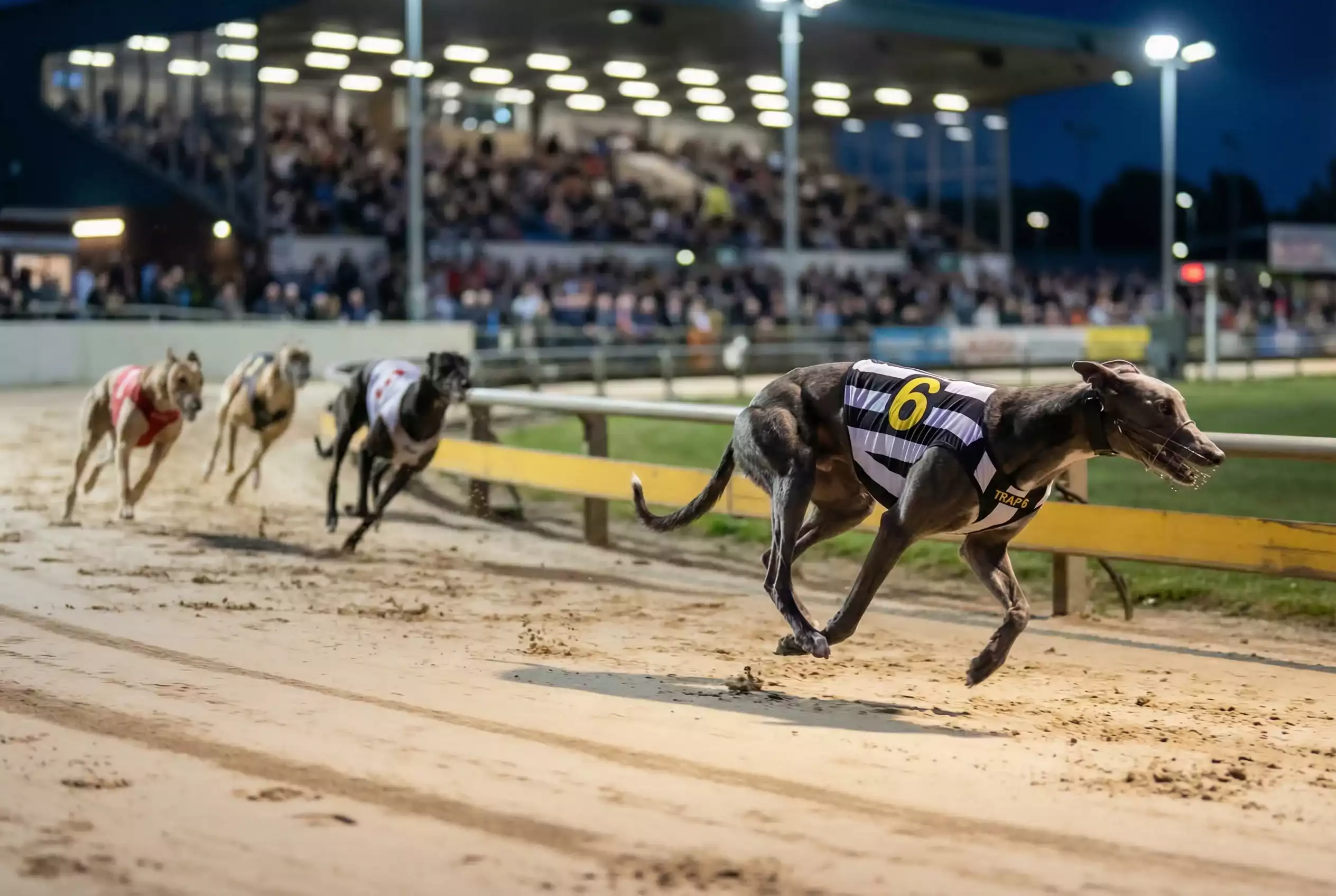
Most greyhound tracks favour inside traps. The rail offers the shortest path, early pace converts to positional advantage, and railers dominate win statistics across the UK. Harlow Stadium defies this pattern. At this Essex venue, the striped jacket of trap 6 wins at rates that would be remarkable anywhere—and that make Harlow a case study in how track geometry shapes trap outcomes.
Where the stripes steal the show. That description fits Harlow better than any other licensed track in Britain. Understanding why requires examining the stadium’s specifications, its unusual outside-trap bias, and what this means for punters seeking value in an atypical market.
Every other venue is profiled in the track directory.
Track Specifications
Harlow Stadium operates a 400-metre circumference track with standard race distances of 238m, 415m, and 592m. The shorter sprint distance and the standard trip both feature four bends, while the 592m staying distance adds further turns. Like most UK tracks, Harlow runs anti-clockwise.
The track’s configuration differs subtly from venues where inside traps dominate. The run from the starting traps to the first bend is relatively long, giving dogs time to find their positions before crowding intensifies. The bends themselves are not as tight as at some metropolitan tracks, reducing the centrifugal squeeze that punishes wide runners elsewhere.
Surface conditions at Harlow favour dogs with stamina and running room. The sand-based racing surface drains well, maintaining consistent going in variable weather. Wide runners, who cover more ground than railers, benefit from a surface that does not tire them excessively for that extra distance.
The stadium’s facilities serve a regular racing calendar, with evening meetings throughout the week and afternoon cards adding fixture density. Harlow attracts runners from kennels across Essex and neighbouring counties, creating competitive fields where trap draw can make the difference between winning and losing.
For punters, the physical layout matters because it explains statistical anomalies. A track designed for tight, rail-hugging racing would produce inside-trap bias. Harlow’s design does not, and the numbers confirm what the geometry suggests.
The Trap 6 Phenomenon
According to OLBG statistics, trap 6 at Harlow wins at approximately 21% of races—the highest outside-trap win rate at any GBGB-licensed track. Compare this to the 16.67% theoretical expectation if all traps were equal, or to the even lower trap 6 win rates recorded at inside-biased venues, and Harlow’s anomaly becomes clear.
Why does the outside position work so well here? Several factors combine. The distance from traps to the first bend allows wide runners to establish their line without being forced into traffic. Dogs seeded W (wide) and drawn into trap 6 can exploit their natural running style rather than fighting it. At tracks where the first bend arrives quickly, trap 6 dogs must either swing very wide—adding distance—or try to squeeze inside, risking interference. Harlow gives them space.
The bend geometry also matters. Wider, more gradual bends reduce the time dogs spend cornering, which is where speed differentials compress and collisions occur. Wide runners maintain more of their momentum through Harlow’s bends than they would at tighter tracks. By the time the field straightens for the run home, the trap 6 dog has often held position or even gained ground.
Seeding reinforces these advantages. Dogs allocated to trap 6 under the R/M/W system are those identified as wide runners by racing managers. They are selected for this position because their previous performances show a preference for outside racing. At Harlow, that selection aligns with track conditions, creating a positive feedback loop where wide runners drawn wide outperform expectations.
The contrast with other tracks sharpens the picture. At Romford, with its tight 400-metre circuit and quick first bend, trap 1 dominates and trap 6 struggles. At Towcester, the bias tilts toward inside positions though less severely. Harlow inverts these patterns. A punter accustomed to backing railers must recalibrate completely when switching to Harlow, or they will systematically overlook value in the outside boxes.
Historical data confirms the persistence of this bias. Trap 6 at Harlow has outperformed theoretical expectations across multiple years, suggesting that the effect is structural rather than a statistical fluke from a small sample. The 355,682 races run across all UK tracks in 2024 included Harlow’s contribution to this dataset, reinforcing confidence in the pattern.
None of this guarantees trap 6 victories. A slow-breaking wide runner still loses to a fast-breaking railer. But across a large sample—hundreds or thousands of races—the statistical edge for Harlow’s outside position is real and measurable. Punters who recognise this edge can adjust their assessments accordingly.
The wider context is set out in our guide to UK greyhound traps.
Betting Angles
The practical question for punters is whether Harlow’s trap 6 bias translates into betting value. The answer depends on whether the market has already priced in the advantage.
At major tracks with well-documented biases, bookmakers adjust their tissue prices to reflect expected trap performance. If trap 6 at Harlow is known to win 21% of the time rather than 16.67%, odds should contract accordingly. Sophisticated punters seeking value must look beyond raw win rates to find spots where the market underestimates a particular dog’s chances.
That value often emerges in specific race configurations. A trap 6 runner with strong sectional times from wide draws, facing a field of railers and middle runners who may interfere with each other at the first bend, represents a scenario where the outside position offers maximum advantage. Conversely, a trap 6 runner with slow early pace facing a field of fast breakers may struggle despite the track bias.
Combining Harlow’s trap 6 bias with form analysis yields the best results. Look for dogs whose recent runs show they can lead or sit handy from wide traps, whose times suggest competitive pace, and whose seeding confirms a genuine wide-running style. Back those dogs at Harlow when the price reflects doubt rather than confidence.
The “Inside vs Outside” betting market takes on different characteristics here. Where most tracks favour inside selections, Harlow inverts the usual logic. Punters betting “outside traps” (4, 5, 6) at Harlow may find more consistent returns than they would applying the same approach elsewhere.
Key Takeaway
Harlow Stadium stands out among UK greyhound tracks for its remarkable trap 6 bias. The 21% win rate for the striped jacket—highest of any outside position nationally—reflects track geometry that favours wide runners rather than punishing them. A longer run to the first bend, wider curves, and consistent surface conditions all contribute. As Mark Moisley, GBGB’s Commercial Director, has acknowledged: “Revenue from bookmakers is declining year-on-year”—yet tracks like Harlow that offer unique betting angles continue to attract punters who appreciate the sport’s statistical depth. For bettors, Harlow demands adjusted thinking: the outside position carries genuine advantages here, and betting strategies should reflect that reality. Where the stripes steal the show, the smart money pays attention.
