
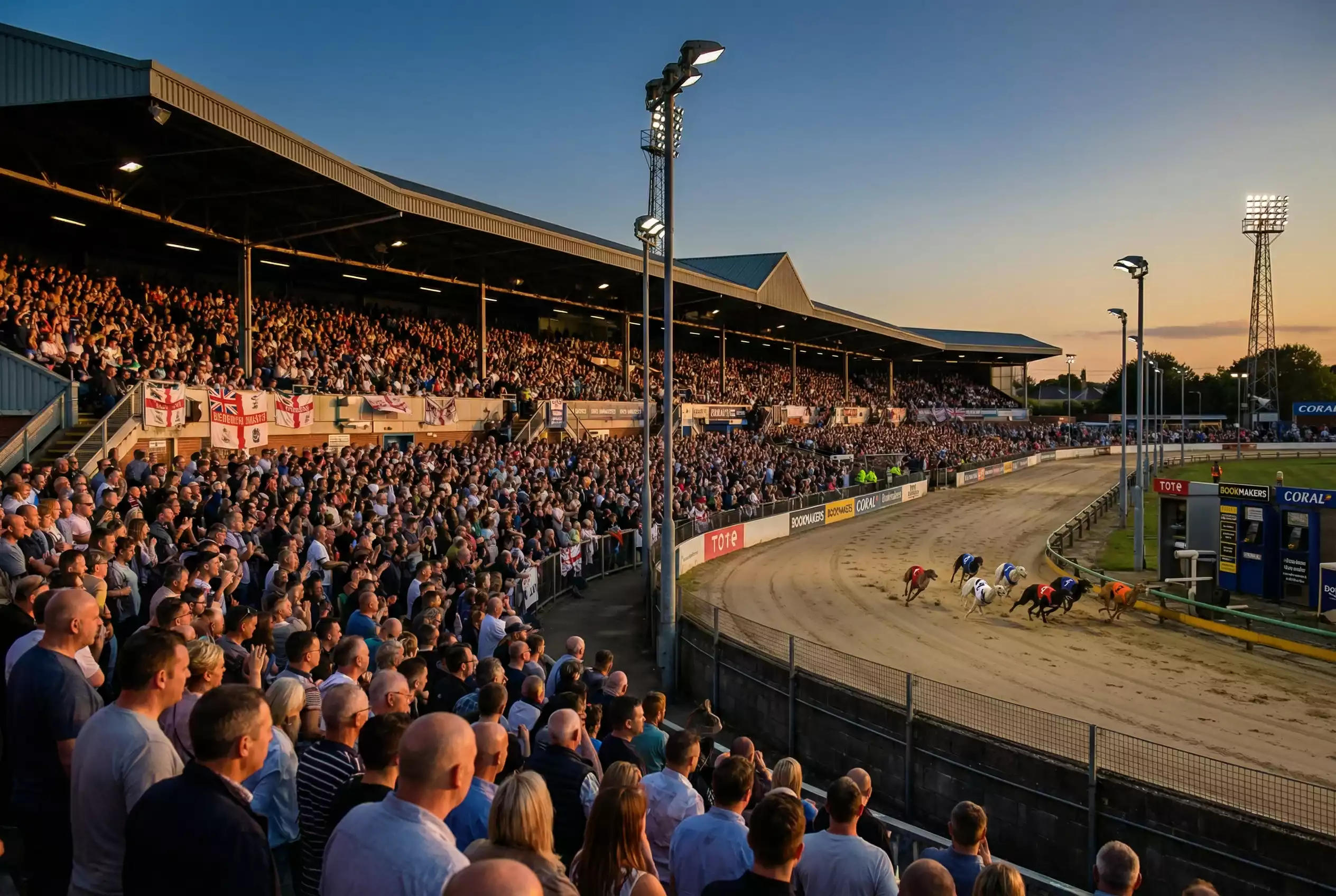
Greyhound racing in Britain is smaller than it once was, but it remains a substantial industry. Nineteen licensed stadiums host racing throughout the year, generating betting turnover measured in billions and employing thousands directly and indirectly. The sport’s scale tells its own story—of resilience, adaptation, and ongoing challenges.
Understanding the industry’s structure helps contextualise everything from trap statistics to welfare debates. This overview presents UK greyhound racing as it stands in 2026: the number of tracks, the volume of racing, the money flowing through the sport, and the pressures shaping its future. Data comes from GBGB reports, betting industry analysis, and public records.
Where it is heading is in the future of UK racing.
Industry by the Numbers
As of early 2026, GBGB licenses 19 greyhound stadiums across England. Scotland’s last licensed track, Thornton, closed in March 2025. Wales has no licensed tracks and has legislated to ban the sport entirely from 2027. Northern Ireland operates under separate regulation and is not included in GBGB figures.
Those 19 tracks hosted 355,682 races in 2024, averaging nearly 20,000 races per stadium annually. Race cards run multiple evenings per week at most venues, with afternoon meetings filling gaps. A single race card typically features twelve races, each with six dogs, meaning roughly 4,000 individual race starts per track per year.
The greyhound population supporting this volume is substantial. GBGB registered 5,133 new greyhounds in 2024, down from 6,769 in 2021. This decline reflects both economic pressures on breeding operations and deliberate efforts to match supply with demand, reducing the number of dogs that might struggle to find racing homes. British-bred greyhounds now constitute 15.5% of registrations, up from 13.1% in 2021, with the remainder imported primarily from Ireland.
Track distribution clusters in certain regions. London and the South East support several stadiums including Romford, Crayford (closed January 2025), and Harlow. The Midlands hosts Monmore Green in Wolverhampton and Perry Barr in Birmingham. Northern England retains a presence with venues like Belle Vue in Manchester and Newcastle. This geography means that most of the English population lives within reasonable travel distance of a licensed track.
Attendance figures are harder to pin down than race counts, as many tracks do not publish detailed admissions data. Industry estimates suggest aggregate attendance has stabilised after decades of decline, with evening meetings drawing crowds from a few hundred to several thousand depending on the venue and the prominence of the race card. The shift toward televised and streamed racing has changed how many experience the sport—watching from home or in betting shops rather than trackside.
New stadium development remains rare, though Dunstall Park opened in September 2025, demonstrating that investment in greyhound facilities has not stopped entirely. More common are closures and conversions, with former track sites becoming housing or retail developments. The industry’s physical footprint has shrunk considerably from the 77 tracks operating in the 1940s.
Economic Impact
Betting drives the economics of greyhound racing. According to analysis from industry reports, approximately £1.81 billion was wagered on UK greyhound racing in 2024, representing roughly a quarter of global greyhound betting turnover. This figure includes both on-track betting through tote pools and off-track betting through licensed bookmakers online and in retail shops.
The relationship between racing and betting is symbiotic but contentious. Bookmakers benefit from the content—frequent races, quick turnover, straightforward betting markets—but their financial contributions to the sport have declined in real terms. Mark Moisley, GBGB’s Commercial Director, has noted publicly: “Revenue from bookmakers is declining year-on-year and has done for a number of years.”
The British Greyhound Racing Fund, which channels bookmaker contributions to welfare and prize money, collected £6.75 million in 2024-25. This voluntary levy of 0.6% on greyhound betting turnover has faced criticism as inadequate compared to the statutory levy supporting horse racing. Campaigns for a mandatory greyhound racing levy have gained political support but not yet succeeded. The gap between what bookmakers earn from greyhound racing and what they return to the sport remains a source of industry frustration.
Employment extends across multiple sectors. Trainers, kennel hands, track staff, veterinarians, stewards, and catering workers all depend on racing directly. Indirect employment through betting shops, media coverage, and supply chains adds further. Precise employment figures are elusive, but industry estimates suggest several thousand jobs nationally rely on greyhound racing continuing.
Prize money motivates participation. Open races at major venues offer purses that make competitive greyhound training viable, while graded races at all levels provide income streams for smaller kennels. The economics work for trainers when dogs win frequently enough to cover costs—feeding, housing, veterinary care, travel—which depends partly on being allocated to traps that suit their running style.
The wider context is set out in our guide to UK greyhound traps.
Future Challenges
Legislative pressure represents the most immediate threat to the industry’s footprint. Wales will ban greyhound racing from 2027 under legislation introduced in September 2025, though no licensed tracks currently operate there. Scotland’s bill to prohibit racing is progressing through parliament following the closure of Thornton. England remains the heartland, but animal welfare campaigners continue pressing for restrictions.
Financial sustainability concerns even those who support the sport. Declining bookmaker revenue, competition for leisure spending, and rising operating costs squeeze margins for both tracks and trainers. Some venues have closed in recent years; others survive by diversifying into non-racing events or property development on stadium land. The industry must find new revenue streams or accept further contraction.
Welfare criticism has intensified despite improving statistics. Organisations like Dogs Trust and the RSPCA argue that injury and retirement data, while better than before, still represent unacceptable harm. The industry responds with evidence of progress and comparisons to other animal sports, but reputational challenges affect sponsorship, media coverage, and political goodwill.
Against these headwinds, the sport retains loyal participants and audiences. The centenary celebrations in 2025 demonstrated that greyhound racing still generates passion among those who grew up with it or discovered it recently. Whether passion translates into a viable long-term future depends on economic, regulatory, and cultural factors that no single stakeholder controls.
Key Takeaway
UK greyhound racing in 2026 is a sport of significant scale—355,682 races annually, £1.81 billion in betting turnover, 19 licensed tracks—but also a sport under pressure. Revenue from bookmakers is declining, legislative bans are spreading in devolved nations, and welfare critics maintain scrutiny despite statistical improvements. The sport’s scale tells its own story: substantial enough to matter economically and culturally, yet vulnerable to forces that could accelerate its contraction. Understanding this context helps explain why trap allocation, grading, and welfare standards receive the attention they do. Every race card exists within an industry fighting to justify its future.
