
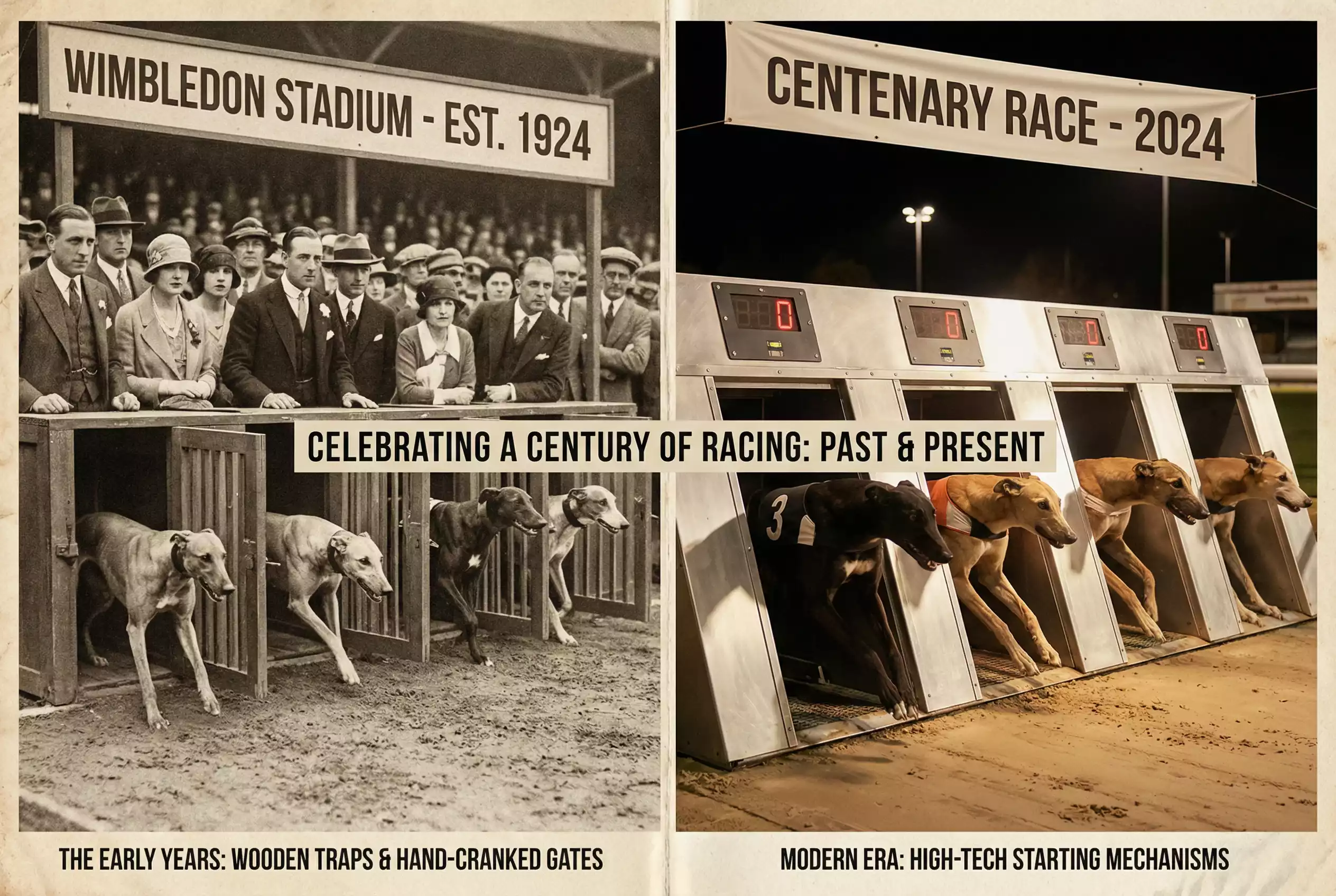
Before there were traps, there were men with leashes. Early attempts at organised greyhound racing relied on human handlers restraining dogs behind a starting line, then releasing them on signal. The results were chaotic: uneven starts, disputed finishes, and races that resembled scrums more than sport. The mechanical starting trap changed everything.
From a single evening in Manchester in 1926 to a network of 19 licensed stadiums today, the trap has shaped British greyhound racing at every stage. It standardised the start, enabled fair betting, and gave the sport its distinctive visual rhythm—six dogs bursting from numbered boxes in pursuit of a mechanical hare. A century of chasing, and counting.
How they work today is in starting box mechanics.
The First Races: Belle Vue 1926
The official birth of British greyhound racing occurred on 24 July 1926 at Belle Vue Stadium in Manchester. An American named Owen Patrick Smith had already developed mechanical hare and trap systems in the United States, and British promoters imported the concept across the Atlantic. Belle Vue hosted the inaugural meeting, drawing crowds who had never seen anything like it: dogs sprinting from starting boxes in pursuit of a motorised lure circling the track.
The event was an immediate sensation. Within weeks, additional tracks opened across England. By 1927, the sport had spread to London with White City Stadium becoming the flagship venue. The timing was perfect. Working-class audiences sought affordable entertainment, and greyhound racing delivered short, frequent contests that suited evening schedules and modest wages. The tote betting system, also imported from America, gave punters a transparent pool to wager into.
Those early traps were rudimentary by modern standards. Metal boxes with spring-loaded doors, manually reset between races, prone to malfunction. A sticky door could delay one dog by fractions of a second—an eternity when races are won by lengths. Handlers loaded dogs into the boxes by hand, backing them into position so they faced forward when the doors opened. The process required skill and calm nerves, both from the handler and the dog.
But the core principle held: all six dogs started simultaneously, eliminating the chaos of hand-held releases. The trap made greyhound racing a sport rather than a spectacle. Punters could assess each runner’s chances knowing that no dog would receive an artificial advantage from a faster release. Bookmakers could price markets with confidence. Stewards could rule on bumping and interference without first having to adjudicate disputed starts.
The 1930s and 1940s saw explosive growth. By 1946, annual attendance across British tracks reached 70 million, a figure that sounds implausible until you consider that evening meetings ran multiple nights per week at dozens of stadiums. Post-war Britain craved distraction, and greyhound racing provided it cheaply. The trap, by now standardised across venues, had become as familiar to punters as the turnstile and the tote window. What began as an American novelty had embedded itself into British sporting culture.
Evolution of Starting Boxes
Early traps relied on mechanical linkages: a single lever or cable triggered all six doors at once. The system worked, mostly, but wear and misalignment created inconsistencies. A trap that opened a fraction slower gave its occupant a disadvantage invisible to spectators but obvious to trainers. Complaints about unfair starts plagued the sport throughout its early decades.
The introduction of electric release mechanisms in the 1950s and 1960s improved reliability. Solenoid-actuated latches replaced spring tension, reducing the variance between traps. Maintenance crews could test and calibrate each box before racing, ensuring that all six doors opened within milliseconds of each other. The technology was not revolutionary—solenoids had existed for decades—but its application to greyhound racing raised standards considerably.
Materials evolved alongside mechanics. Early traps were heavy steel constructions, difficult to move and expensive to maintain. Later designs incorporated lighter alloys and modular components. Tracks could swap out individual trap units for repair without dismantling the entire starting assembly. Standardisation across the industry meant that a dog racing at Romford on Tuesday and Towcester on Thursday encountered identical starting conditions.
The modern trap is a precision instrument. Doors open simultaneously to tolerances measured in hundredths of a second. Sensors confirm that each door has cleared before race timing begins. Photoelectric gates detect dogs leaving the box, feeding data into timing systems that record first-bend sectionals. What started as a metal cage with a spring has become an integrated component of race technology, ensuring fair starts across the hundreds of thousands of races run each year.
Professor Madeleine Campbell, who led development of GBGB’s welfare strategy, noted the importance of such standards: “In leading the development of the GBGB Strategy, I spoke to academics, specialists, vets, global experts in animal welfare and a wide range of stakeholders to ensure that what we have put in place is world class in its approach to the welfare of greyhounds.” That world-class approach includes the equipment dogs race from.
The wider context is set out in our guide to UK greyhound traps.
The Centenary Year: 2025
2025 marked one hundred years since that first meeting at Belle Vue. The industry celebrated with commemorative events, historical exhibitions, and renewed debate about its future. Much has changed: from 77 licensed tracks in the 1940s, the number has shrunk to 19 GBGB-licensed stadiums in England as of 2026. Attendance figures no longer approach post-war peaks. Betting has migrated online, and televised racing competes with countless other diversions.
Yet the trap endures. Every race in 2025 began the same way as those first races in 1926: six dogs in numbered boxes, a mechanical hare in motion, and doors springing open at the starter’s signal. The principle that Owen Patrick Smith imported from America remains the foundation of the sport. Improvements in materials, electronics, and safety have refined the experience without altering its essence.
The centenary year also brought challenges. Wales announced legislation to ban greyhound racing by 2027, and Scotland moved toward similar restrictions. The number of tracks may continue to decline. But as long as racing continues, the trap will remain central—a device that turned a chaotic pursuit into a regulated, watchable, bettable sport. A century of chasing—and counting.
Key Takeaway
The starting trap transformed greyhound racing from a novelty into a sport. From Belle Vue’s 1926 debut to the centenary celebrations of 2025, the trap has provided the standardised, simultaneous start that makes fair competition and reliable betting possible. The mechanics have evolved—spring-loaded doors gave way to solenoid releases, steel boxes to precision-engineered assemblies—but the function remains constant. Every modern race begins exactly as those first races did: six dogs, six boxes, one moment. A century of chasing, and counting.
