
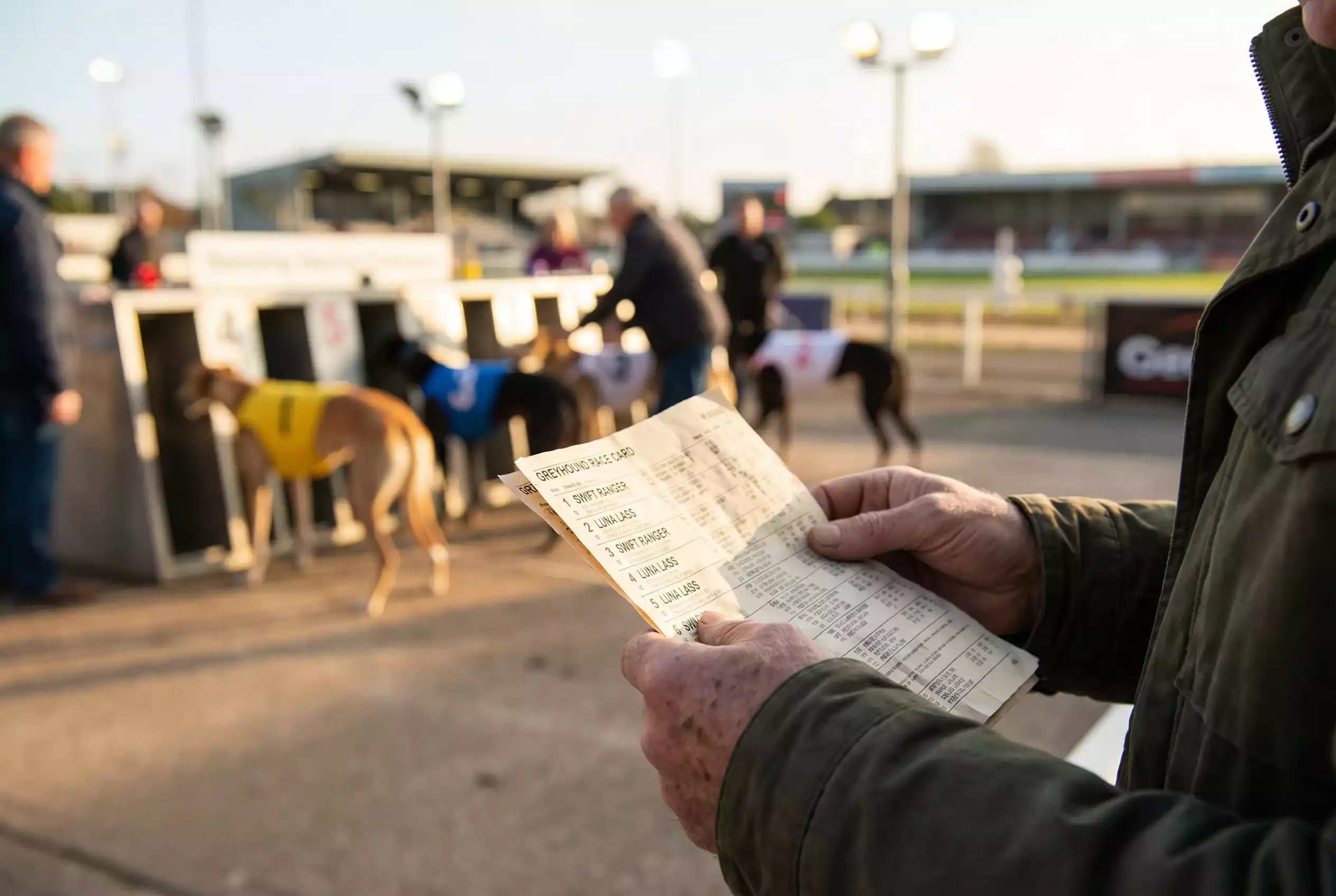
A greyhound race card is a dense slab of information compressed into a few lines per dog. To the uninitiated, it looks like alphabet soup: numbers, letters, abbreviations, and symbols jostling for space. To the informed punter, every symbol tells a story—of past performances, running style, and likely trap behaviour.
Learning to read a race card is the first serious step toward making informed selections rather than guessing. The trap number and jacket colour identify position. The seeding code reveals running style. The form figures trace recent history. Put them together and you have a snapshot of what each dog brings to the race. This guide breaks down those elements so that the next time you open a race card, the data speaks clearly.
The seeding codes on it are explained in seeding.
Understanding Trap Numbers and Colours
Every greyhound race card lists six dogs, numbered 1 through 6 according to their starting trap. Trap 1 is the innermost position, hugging the rail. Trap 6 sits on the outside. These numbers correspond to jacket colours that remain consistent across all UK tracks: trap 1 wears red, trap 2 blue, trap 3 white, trap 4 black, trap 5 orange, and trap 6 black-and-white stripes.
The colours serve a practical purpose. When six dogs blur around a bend at 40 miles per hour, identifying individuals by ear tag is impossible. The jackets let spectators, stewards, and camera operators track each runner instantly. They also help punters watching on screens—whether trackside or via live streaming—follow their selection without confusion.
On the race card itself, the trap number appears prominently, often with a coloured box or icon matching the jacket. Some cards display only the number; others show a small visual cue. Either way, the trap position is the first piece of information to absorb. It tells you where the dog will start and, by extension, what kind of run it will need to reach the front.
Trap 1 dogs have the shortest path to the first bend but face crowding if slower to break. Trap 6 dogs have more room but cover extra ground. Traps 3 and 4 occupy the middle, avoiding the extremes. These positional dynamics shape race outcomes in ways that raw speed alone cannot predict. A fast dog from the wrong trap can still lose to a slower dog with cleaner running room. That is why trap numbers demand attention before anything else on the card.
Decoding R/M/W Seeding Codes
Next to each dog’s name, most race cards display a single letter: R, M, or W. These seeding codes, mandated by GBGB regulations, classify each greyhound’s preferred running style and determine which traps it can be drawn into.
R stands for railer. A railer is a dog that naturally seeks the inside rail, hugging the shortest path around bends. Railers are seeded into traps 1 and 2, where they can exploit their style from the break. If a railer starts from trap 5 or 6, it must cut across traffic to reach its favoured line—a manoeuvre that invites interference and burns energy. Seeding prevents this mismatch.
M stands for middle runner. These dogs show no strong preference for inside or outside, running wherever the race takes them. They are flexible, often finishing well regardless of trap. Middle runners draw traps 3 and 4, the central positions that give them options on either side. They can move inside if space opens or push wider to avoid trouble.
W stands for wide runner. Wide runners swing to the outside, taking the long way around bends but avoiding congestion. They need room to stride out and often accelerate late when the rail is blocked. Wide runners are seeded into traps 5 and 6, starting where they intend to race.
The seeding code is not a prediction—it is a classification based on observed behaviour. Racing managers assign or reassign seeds as dogs demonstrate consistent patterns. A young dog might start as M until its style clarifies, then shift to R or W once it shows a preference. The code reflects what the dog has done, not what it might do.
For punters, seeding codes reveal whether a dog is well drawn. A railer in trap 1 is perfectly placed. A railer in trap 4 (possible in some open or feature races where seeding rules relax) faces obstacles. Matching the seeding code to the actual trap position is one of the fastest ways to assess a dog’s chances before reading anything else.
The wider context is set out in our guide to UK greyhound traps.
Form Figures and What They Mean
The string of numbers following each dog’s name represents its recent finishing positions, read from left to right as oldest to most recent. A sequence like 3-2-1-1-2 tells you the dog finished third, then second, then won twice, then second again. The most recent run sits on the far right—the freshest data point.
Figures typically cover the last six runs, though some cards show fewer for dogs with limited history. A dog displaying only three numbers is either new to racing or returning after a layoff. That scarcity of data is itself informative: less form means more uncertainty.
Certain symbols interrupt the numbers. An F indicates a fall, a serious incident where the dog went down during the race. An M denotes a meeting where the dog ran but was caught up in interference. A dash or hyphen sometimes marks a race where the dog was withdrawn before the off. These symbols matter because they explain anomalies. A dog showing 1-1-6-1-1 looks inconsistent until you see that the 6 was actually an F—a fall that dropped it to last but says nothing about its ability.
Race cards also list the trap position the dog ran from in each previous race, often in brackets or as a superscript. A form line reading 1(3)-2(4)-1(2) shows that the dog won from trap 3, finished second from trap 4, and won again from trap 2. This context is vital. A dog that wins repeatedly from trap 1 but has never run from trap 6 is an unknown quantity when drawn wide. Conversely, a dog that performs well from multiple trap positions demonstrates versatility.
Times accompany form figures on detailed cards. These sectional and finishing times let you compare pace: a dog that runs 24.50 seconds over 400 metres at Romford operates at a different level from one clocking 25.20. Combined with trap history, times complete the picture. Every symbol tells a story—learn to read it, and the race card becomes a map of probabilities rather than a puzzle.
Key Takeaway
Reading a greyhound race card is a skill that separates casual punters from serious students of the sport. The trap number tells you where the dog starts. The jacket colour lets you track it visually. The seeding code reveals running style and whether the draw suits. The form figures trace recent performance, with symbols flagging incidents that numbers alone would hide. Together, these elements form a compact dossier on each runner. As Tiffany Blackett, Executive Veterinarian at GBGB, noted regarding the sport’s commitment to transparency: “We are delighted to share the latest progress report on GBGB’s long-term welfare strategy.” That same transparency extends to race cards, where every symbol serves punters seeking informed decisions. Master them and you will spot value that others miss—dogs whose ability exceeds their odds because their card tells a story the market has not fully absorbed.
